
Medics urge Ugandans to know their sickle cell status early
According to Dr Ajambo, early screening helps prevent the disease and enables individuals to make informed decisions before marriage.
Religious leaders led by Ronald Mukuru (second left), the diocesan secretary of Masindi-Kitara Diocese, and DPC Pensive Tukasiima (left), among others, participate in the walk. (Photo by Yosam Gucwaki)
________________ Health workers screen Masindi residents for sickle cell disease. (Photo by Yosam Gucwaki)
Medics in Masindi and at various levels are advocating for early screening for sickle cell disease as a crucial strategy to reduce its incidence among the population.
The call was made by Dr Miriam Ajambo, the national coordinator for sickle cell disease at the Ministry of Health, who was represented by Dr Peter Kisembo, an associate consultant physician at Masindi Kitara Medical Centre.
The call was made during the Masindi Sickle Cell Awareness Run 2026, held on September 26, 2026, at Masindi Kitara Diocese. The event, themed "Run for Awareness, Race for a Cure," included free sickle cell screening and blood donation, among other activities.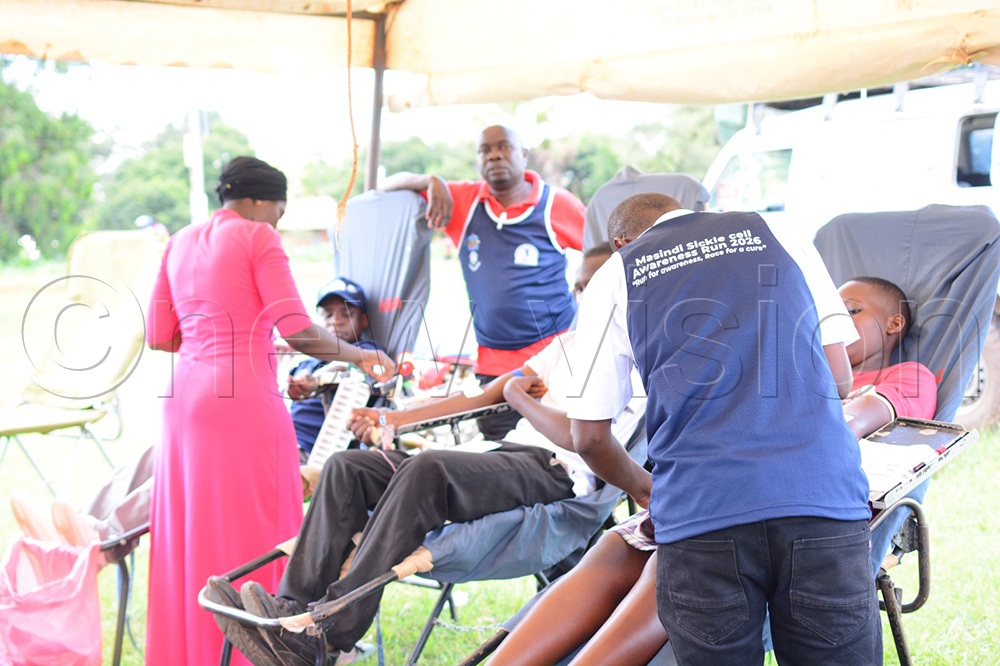
According to Dr Ajambo, early screening helps prevent the disease and enables individuals to make informed decisions before marriage.
She added that the Ministry of Health is currently strengthening policies and improving access to care and treatment.
"Awareness and early diagnosis make treatment and management easy. Late diagnosis is the biggest challenge sickle cell victims are grappling with in the country," Dr Ajambo explained.
Dr Ajambo noted that in February this year, the Ministry of Health launched a programme to screen newborn babies before they leave hospital.
"A baby born with sickle cell is not different from another newborn normal baby. Early diagnosis helps to put a child on medication, and that's the power of early detection," she said, emphasising that people should not wait for a baby to become critically ill to realise they have sickle cell disease.
"Today we are at a very important turning point, and our approach towards sickle cell is a bit different. We are moving away from the system where we have been waiting for the child to get sick, but now we are detecting it early. It calls for a joint effort between parents and health workers," Dr Kisembo stated.
He stressed the need to encourage young people and adults to understand their sickle cell status before marriage.
"It's not about preventing you from getting married, but it's about prevention, making informed decisions, and counselling. Early screening is enough because after that, we link you to the appropriate care," Dr Kisembo added.
Dr Kisembo also cautioned the people of Masindi and Bunyoro against stigmatising people living with sickle cell disease.
He urged community members, politicians, religious leaders and cultural leaders to combat stigma and ensure that those affected live improved lives.
"Sickle cell is one of the most expensive diseases to treat after complications have intensified. We have seen families break, husbands leaving their wives because they've produced children with sickle cell. Most times it's the mothers who suffer to give care, yet it should be a combined effort," Dr Kisembo said.
He further revealed that in Bunyoro, one in four people is either a sickler or a carrier, and that the biggest challenge in the region is the scarcity of information about the disease.
"We need to increase our visibility such that we tell a story from an informed point of view and get a solution," he said, noting that no sickler is supposed to die early, but they do due to late presentation for care; it happens.
Annette Nabukeera Kagoro, CEO of the Austin Sickle Cell Support Organisation, which organised the run, expressed their desire for people to understand sickle cell disease to facilitate its prevention and treatment.
Salome Kasangaki, an administrator from Osepadel Medical Services, encouraged the people of Masindi to embrace free services such as screening to learn their status.
She commended the Austin Sickle Cell Support Organisation and Kitara Medical Centre for providing free care to vulnerable individuals.
Rev. Canon Ronald Mukuru, diocesan secretary of Masindi Kitara Diocese, representing Bishop Joshua Kugonza, called for continuous sensitisation across all sectors, affirming the church's commitment to leading the sensitisation campaign.
"There are a lot of people suffering silently. Some people in the community are hiding and also stigmatising victims, which is uncalled for. As a church, we are going to speak against this," he said.
More than 200 people were tested for the disease, while more than 100 donated blood. Various organisations and individuals also received certificates of participation for their involvement in the running and walking activities.
About sickle cell disease
Sickle cell disease is a genetic disorder that affects haemoglobin production in red blood cells.
Statistics indicate that approximately 13.3% of Uganda's population carries the sickle cell trait, about 1 in 7 people.
Around 0.8% of the population in Uganda has sickle cell disease, meaning about 1 in 125 people.
It is estimated that 20,000 babies are born with sickle cell disease in Uganda each year, while approximately 15,000 babies with the disease die before the age of five, underscoring the critical need for early diagnosis and intervention.
The prevalence of the sickle cell trait varies across regions, with the highest rates found in the Western and Central regions, at up to 23.9%, and the Northern region, at 22.2%. Some parts of Uganda have reported prevalence rates as high as 25%.