
Ugandan cancer survivor Nakigudde advocates for affordable innovations
At the ongoing 28th edition of the World Cancer Congress in Hong Kong, Nakigudde, a 24-year survivor and healthcare leader, stated, "Since treatment is only in Kampala, patients have to pay for transport fare, accommodation, meals, and diagnostics. Even the bits of medicine that are not provided by government are not affordable.
Nakigudde, who leads efforts to bridge the gap between rural communities and cancer care, said most Ugandan patients live 100 to 200 kilometres from the Uganda Cancer Institute in Kampala, the country's only national centre. (Credit: John Musenze)
HONG KONG - Ugandan breast cancer survivor and advocate Gertrude Nakigudde has called for global cancer innovations to be made affordable and accessible to patients in low-income countries, warning that lifesaving advances are reaching Africa last.
At the ongoing 28th edition of the World Cancer Congress in Hong Kong, Nakigudde, a 24-year survivor and healthcare leader, stated, "Since treatment is only in Kampala, patients have to pay for transport fare, accommodation, meals, and diagnostics. Even the bits of medicine that are not provided by government are not affordable.
Scientists are out there, industries are out there to innovate medicines that can treat and cure cancer. But these innovations most of the time don't translate into access," she said.
During the innovation and access session, Nakigudde said that her major goal at the Congress is to push for access to medicines, diagnostics and care.
Ugandan data show approximately 36,000 new cancer diagnoses and over 24,000 deaths annually, with cases rising by 10% between 2024 and 2025 alone. Women account for about 55% of cases.
Nakigudde, who leads efforts to bridge the gap between rural communities and cancer care, said most Ugandan patients live 100 to 200 kilometres from the Uganda Cancer Institute in Kampala, the country's only national centre.
“Many women delay care because they have to choose between feeding their children and going to Kampala for treatment. By the time they arrive, the disease is often advanced,” she said.
She described her daily reality of patients coming to her office to fundraise for medicines, scans and check-ups that are charged out-of-pocket. Most cancers in Uganda, she said, are detected at late stage when treatment is more expensive, and survival is lower
"My call to African governments is to work with other partners to ensure that prices go down for medicines but also to ensure that there is a budget for medicines," she said. "Diagnostics must be provided so that accurate diagnosis is done promptly before diseases are advanced.
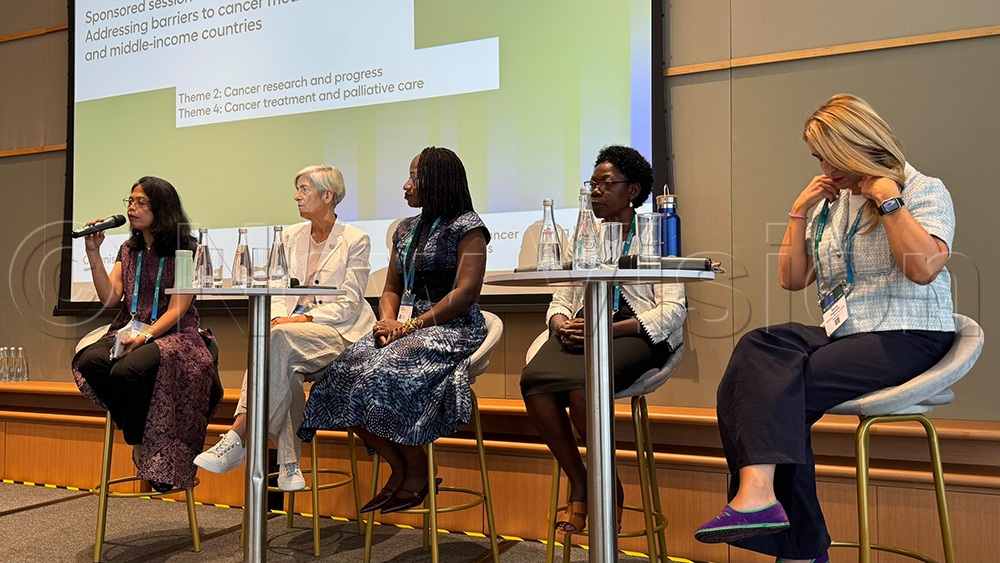
Nakigudde from the second right during a panel session on access and innovation. (Credit: John Musenze)
First African UICC president pledges bridge to Global South
The call for equity was echoed by Dr. Zainab Shinkafi Bagudu, president-elect of the Union for International Cancer Control (UICC) and the first African to hold the position
Bagudu, a former First Lady of Kebbi State, Nigeria, said her election reflects growing awareness that cancer is tripling in the Global South and that low- and middle-income countries have been left behind.
"It took so long to have an African president, and that is a reflection of the inadequacy of cancer care along the entire spectrum in Africa. People affected by it most are those from the Global South," Bagudu said in an interview.
She said her vision is to act as a bridge to tap into new technology, artificial intelligence, new drugs and new approaches to care and end-of-life care for LMICs.
"I have this opportunity to bring forth a lot of the problems that low- and middle-income countries are facing to the Global North," she said, noting that UICC spans over 170 countries and 1,200 member organisations
She also pointed to new financing models, including a proposed global cancer financing platform modelled on the Global Fund for HIV, to reduce financial toxicity for patients
“We keep building cancer centres, and we keep seeing that it's not enough," "What I am trying to do is reduce financial toxicity for the woman in the village,” she said.
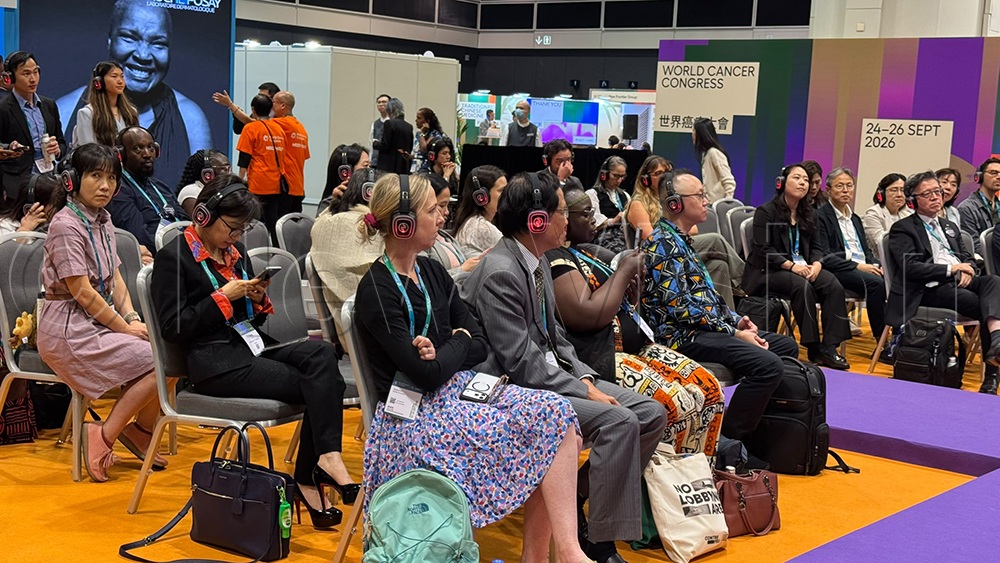
Delegates at the World Cancer Congress 2026 in Hong Kong listening during a session. (Credit: John Musenze)
WHO-progress made, but gaps remain
In a virtual address to delegates, WHO Director-General Dr. Tedros Adhanom Ghebreyesus said the world has made encouraging progress: tobacco use has dropped by one-third globally and cervical cancer elimination is now possible but inequities persist.
In WHO's first global survey of people with cancer, more than half reported mental illness, and half reported severe financial hardship, including having to sell their homes to pay for care
“Inequities persist, with major survival differences between high- and low-income countries and premature cancer mortalities rising in 48 countries. We can and must close these gaps. We know what works. The gap is in implementation and inclusiveness,” Tedros said
He stressed that researchers and innovators have a vital role, but the most important voices are those of people who live with cancer.
“Cancer affects nearly all of us. Our response must include all of us,” he said.