
Who is hosting your university child?
Let us begin a national conversation about protecting our young people.
Barbara Kaija. (File)
_______________
OPINION
The hardest part was saying goodbye! A father placed the last suitcase inside his daughter’s new room. Together, they made the bed, arranged her books, and prayed before sharing a final hug. As he drove home, he felt the profound relief of a parent who had fulfilled his greatest duty: his daughter had made it to university.
While she was fortunate to have a parent drop her off, thousands of other Ugandan students must say their farewells on rural village verandas. They then embark on long, solitary journeys to campuses in Kampala, Mbarara, Gulu, or Arua. Yet, whether dropped off at the dorm door or left at the village bus stage, what these parents cannot see is that the true journey is just beginning. In this new chapter, their protected children must suddenly learn to navigate adulthood in a much harsher world.
Student welfare crisis
Over the next few weeks, universities across Uganda will welcome thousands of freshers. Families nationwide are celebrating admission lists, viewing this milestone as the ultimate fulfilment of years of financial sacrifice. Yet, once the suitcases are unpacked, a harsh, unspoken education begins.
This reality strikes immediately during the nightmare search for affordable housing. Campus halls of residence accommodate only a small fraction of students, forcing the vast majority into the private market. At Makerere University Business School, for example, a private hostel room ranges from sh750,000 to sh2.5m per semester. The story is no different for Makerere or any other university.
Driven by these prohibitive costs, many ordinary students have no choice but to rent cheap rooms in surrounding slums, instantly exposing themselves to severe safety risks.
Compounding this housing crisis is the daily struggle for basic nutrition. Because most institutions do not provide meals, students must stretch meagre family remittances to cover food, clothing, transport, internet data and photocopying. Even government-sponsored students find that their daily allowances fall short, forcing many to quietly settle for a single meal a day.
One Makerere graduate from the First Lady’s Emerging Leaders Programme almost quit his degree due to hunger. “I wasn’t daft,” he recalls. “I was constantly hungry and simply couldn’t afford to eat.” He only completed that semester because a classmate shared meals until allowances arrived. Across campuses, many students carry this hidden burden, trying to learn on empty stomachs.
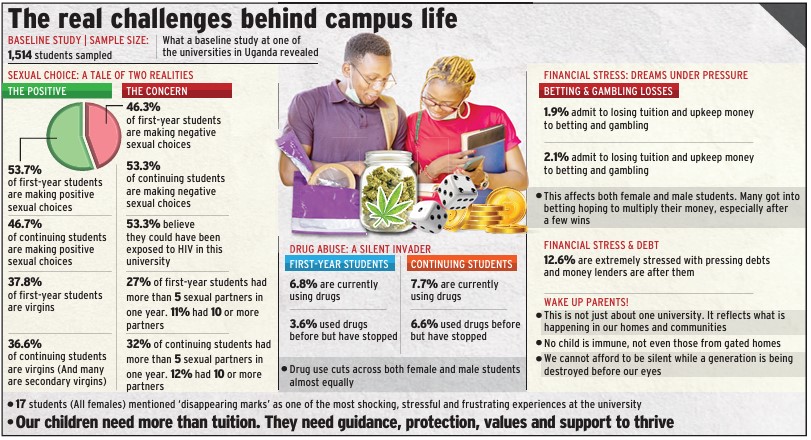
Ahead of the launch of the Emerging Leaders Programme, a baseline study involving 473 first-year students and 1,041 continuing students revealed that many students were navigating significant pressures, including risky sexual behaviour, substance abuse, gambling-related financial losses, debt and academic malpractice, even as the majority continued to make positive life choices as illustrated in the graphic above.
Parents spend years preparing their children to pass examinations. Far fewer conversations prepare them for life outside the classroom. For financial pressure. For unhealthy relationships. For manipulation disguised as kindness. For the courage to say no when nobody from home is watching.
Who finds your child first?
Parents know where they left their children. What they often do not know is who finds them afterwards. The harsh realities introduce other voices too. Someone who offers accommodation with expectations never mentioned at the beginning. Someone who promises quick money. Someone who insists that “everyone is betting now.” Someone who says one drink will help you settle in, forget and face your issues. Somebody always notices vulnerability.
The question is who reaches that student first. This is not a story about fear, nor is it a story about assuming the worst of university life. It is a call for all of us to support our university young adults more.
Uganda is not alone
Across the world, universities are grappling with the rising cost of higher education, student wellbeing and the hidden pressures of the transition into adulthood. What is encouraging is not that other countries have solved these problems- they have not- but that many have recognised them early enough to respond.
In the UK, as is the case at Uganda Christian University in Mukono, many universities secure and guarantee accommodation for first-year students because they recognise that the transition from home is one of the most vulnerable periods in a young person’s life. Residence halls are supported by wardens, peer mentors and wellbeing teams whose role extends beyond administration to community building.
Canadian universities have gone further in strengthening peer support networks, campus food banks and mentoring programmes, recognising that students are often more likely to seek help from fellow students before approaching university authorities.
What these countries have recognised is that academic excellence alone is not enough. Young people flourish when they are surrounded by relationships, practical support and communities that notice when they are struggling.
Back home, the Emerging Leaders Programme, an initiative by Maama Janet Museveni, foregrounds nurturing sexually-fortified, addiction-free, financially faithful and education-focused students. These are not slogans. They are responses to realities many young people encounter within weeks of arriving at university. The challenge is not simply to produce graduates. It is to help young men and women emerge with their character, dignity and purpose intact.
It takes a village
Uganda’s distinct circumstances require localised solutions, yet the fundamental principle remains unchanged: it still takes a village to raise young adults. Addressing this challenge demands strong partnerships, meaning every sector of society has a vital role to play in supporting students.
Resolving this welfare crisis requires a collective shift in responsibility; while the state must expand financial aid and subsidise campus housing, universities must proactively regulate nearby private rentals and establish subsidised food programmes. Meanwhile, private landlords must stop exploiting desperate youths with predatory pricing, and local communities, including churches and mosques, must step up to provide secure, affordable environments.
Crucially, internal stakeholders must lead this transformation from within. Student guilds must move beyond traditional politics to launch practical welfare initiatives, such as establishing emergency food banks and peer-led housing registries to negotiate group discounts with landlords. Concurrently, alumni networks must bridge the resource gap by setting up targeted welfare endowments, mentorship-driven housing stipends, and work study partnerships. Higher education is a collective societal investment; protecting our students is a duty that belongs to all of us.
The new academic year starts this week. Let us begin a national conversation about how we prepare, protect and walk alongside the young people to whom we are entrusting our country’s future.
Kaijabarbara@gmail.com The writer is an educationist, a media development and communication specialist and the chairperson of the board for the Emerging