
PDM stakeholders urged to strengthen monitoring, accountability
PDM is the Government's flagship strategy for accelerating socio-economic transformation by supporting households to move from subsistence production into the money economy.
Santa Sandra Alum (centre), Minister of State for Economic Monitoring, with Dennis Galabuzi Ssozi, National Coordinator of the Parish Development Model (PDM), after a validation workshop for the PDM results at the National ICT Hub
The Government has moved a step closer to establishing a unified system for measuring the performance and impact of the Parish Development Model (PDM), as stakeholders convened in Kampala to validate the programme's Results Framework.
The one-day national stakeholder workshop, organised last week by the PDM Secretariat under the Ministry of Local Government at the National ICT Innovation Hub in Nakawa, Kampala, brought together representatives from the seven PDM pillars and key government institutions responsible for coordination, oversight, monitoring and implementation.
At the heart of the engagement is the PDM Results Framework, which is expected to provide a common yardstick for tracking progress, measuring results and strengthening accountability across the programme's implementation chain from the parish to the national level.
PDM is the Government's flagship strategy for accelerating socio-economic transformation by supporting households to move from subsistence production into the money economy while improving incomes and livelihoods through coordinated service delivery at parish level.
Since its launch in February 2022, the Government says the programme has disbursed Sh4.4 trillion in seed capital to 3.7 million households across 10,589 parishes as part of efforts to drive household-level economic transformation.
The validation workshop is intended to ensure that the Results Framework does more than document activities. It is expected to establish a clear link between government interventions, the results they are intended to produce and the changes experienced by households and communities.
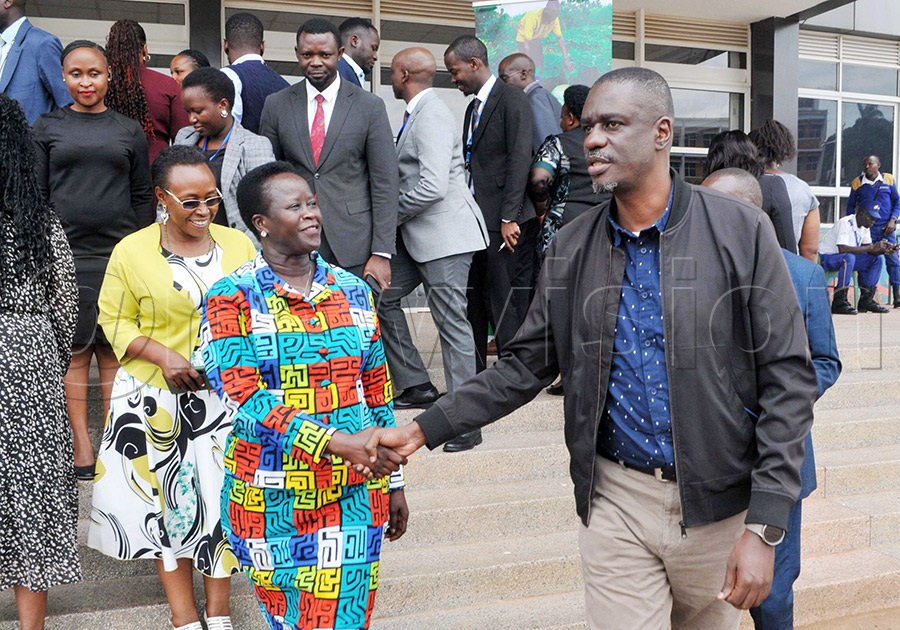
Santa Sandra Alum (left), Minister of State for Economic Monitoring, chats with Dennis Galabuzi Ssozi, National Coordinator of the Parish Development Model (PDM), after a validation workshop for the PDM results at the National ICT Hub
The process will also establish clear performance indices at parish, sub-county, district and national levels, creating a more consistent basis for assessing PDM implementation.
The PDM Deputy Coordinator, Bonnie Kashaija Mutungi, said the validation is designed to give all institutions with a role in the programme a shared stake in the final framework.
"We are here to validate, clean and input, so that this becomes a document that is collectively accepted and collectively owned by all government agencies and departments that have a key role in the implementation, oversight and general success of the PDM," she said.
The Results Framework will also underpin the operationalisation of the Monitoring and Evaluation module of the Parish Development Management Information System (PDMIS).
"Once operationalised, the framework is expected to facilitate systematic data capture, analysis and reporting, enabling Government and other stakeholders to use evidence more effectively in planning, monitoring and decision-making," said Mutungi.
The National Coordinator, Denis Galabuzi Ssozi, said the exercise seeks to establish a unified approach through which PDM performance can be tracked and reported consistently across all levels of implementation.
The framework is also expected to clarify the respective responsibilities of stakeholders in collecting data, reporting results and using evidence to improve implementation.
The Minister of State in charge of Economic Monitoring in the Office of the President, Santa Sandra Alum-Ogwang, who officiated at the opening of the workshop, said the development of the framework follows findings from a process evaluation of the PDM undertaken by her office in accordance with the PDM 2022 guidelines.
The evaluation identified implementation challenges and highlighted the need for a clearer mechanism for measuring results.
"The discussions with stakeholders regarding our findings have shaped the PDM Theory of Change, which sets out how PDM interventions are expected to transform households. The Results Framework must enable us to assess whether that change is occurring," she said.
She noted that the framework should define the results expected across all seven pillars and establish measurable indicators at household, parish and national levels.
"Above all, [it should] help Government establish whether the PDM is improving household incomes and livelihoods by identifying gaps early and acting on findings," she added.
The validation process is also reinforcing the principle that effective implementation and monitoring of the PDM requires a Whole-of-Government approach.
Galabuzi said the framework reflects the contribution expected from different government institutions and offices, including political leaders, at various levels of implementation.
He emphasised that coordinated monitoring by Members of Parliament, District Chairpersons, Councillors and other stakeholders, in liaison with the PDM Secretariat, can help build a common understanding of programme objectives and strengthen collective responsibility for results.
Such coordination, he said, would support shared development outcomes while strengthening oversight of implementation.