
Minister stops Catholic Church from evicting Nsambya estate residents
“Until the land matter is resolved, there will be no eviction,” Mayanja said. He also directed the RCC Baingana to provide security to the residents to ensure their quiet possession of the property.
Mayanja explained that any executive directive issued by a minister acting on behalf of the President must be complied with. (Credit: Ronnie Kijjambu)
KAMPALA - Lands state minister Sam Mayanja has stopped Kampala Catholic Archdiocese from evicting 107 families of 535 lessees from Nsambya Housing Estate in Kampala.
The Archdiocese had given the families 73 days to vacate Nsambya Housing Estate or face forceful eviction. This is according to an advert published in the media on February 16, 2026, by the Registered Trustees of Kampala Archdiocese (RTKA).
The minister issued the directive on February 19 during a meeting convened at Nsambya Housing Estate.
The residents, represented by lawyer Anthony Bazira, attended the meeting, while representatives of the Kampala Archdiocese declined to attend despite having been invited by the Kampala Resident City Commissioner (RCC) for Makindye Division, Mark Baingana.
“The eviction deadline of April 1, 2026, stands vacated indefinitely,” Mayanja directed, drawing applause from the residents. He added that the eviction notice carries no legal consequences.
Mayanja explained that any executive directive issued by a minister acting on behalf of the President must be complied with.
The minister further revealed that prior to the meeting, he held discussions with the head of the State House Anti-Corruption Unit (SHACU), Brig. Gen. Henry Isoke, who agreed to chair a mediation process between the Kampala Archdiocese and the Nsambya Housing Estate residents.
“Until the land matter is resolved, there will be no eviction,” Mayanja said.
He also directed the RCC Baingana to provide security to the residents to ensure their quiet possession of the property.
Mayanja noted that President Museveni issued two directives, dated February 7, 2013, and February 28, 2022, prohibiting the eviction of Ugandans from land. He explained that the directives apply to lessees and carry the force of law, thereby barring evictions under such circumstances.
The minister added that the President’s directives were issued in accordance with Article 98(1) and (2) of the Constitution.
“I am surprised that in the middle of Kampala, someone is attempting to evict 535 people who held a 49-year lease and have made developments on the land. That is unacceptable,” Mayanja said.
How the Church acquired the land
According to Mayanja, the origins of Church land ownership date back to the 1900 Uganda Agreement, under which approximately 19,600 square miles of land were taken from the original province of the Buganda Kingdom and subsequently divided into two portions.
He explained that one portion of the land was taken over by the colonial government, while the other was allocated to a group of collaborators. Mayanja said the second category of land later became known as Mailo land in 1908.
The minister said colonial administrators and private beneficiaries went on to distribute the land among various individuals and institutions, including religious organisations.
He noted that at the time there were three missionary societies operating in the region: Two Catholic missionary societies and one Anglican missionary society affiliated with the Church of Uganda from the United Kingdom.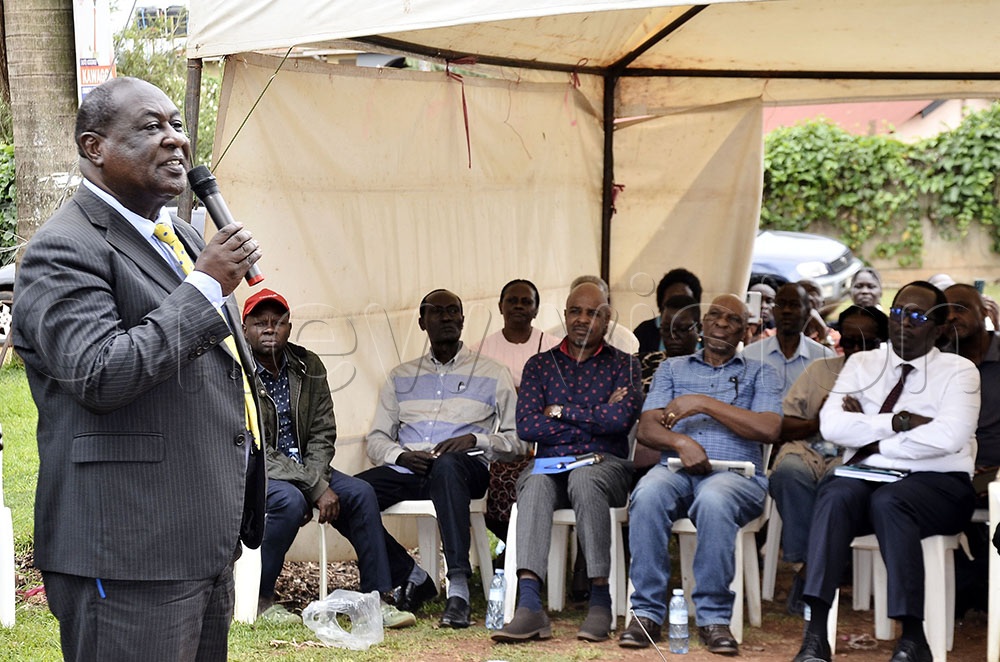
“I am surprised that in the middle of Kampala, someone is attempting to evict 535 people who held a 49-year lease and have made developments on the land. That is unacceptable,” Mayanja said. (Credit: Ronnie Kijjambu)
According to Mayanja, the three missionary societies received 92 square miles of land free of charge, which they then shared among themselves.
He said because the Catholic Church was represented by two missionary societies, it received a larger share of the land, while the Church of Uganda, represented by a single society, received a comparatively smaller portion.
The minister said the historical allocation marked the beginning of large-scale church land ownership in the country.
“The injustice arising from the 1900 Agreement has, after decades, been passed down to the present generation. However, this will not be allowed to continue because the law in this country protects individuals who are in lawful possession of land,” he added.
Affected residents speak out
Allan Agaba, the chairpersonn of the taskforce against eviction, read the memorandum of all the affected families on their behalf. He said they acknowledge the legal framework governing leasehold tenure and the rights of registered landowners.
“However, we seek a balanced, lawful, and humane resolution that considers both property rights and the constitutional principles of dignity, fairness, and social justice,” he said.
Agaba noted that the affected residents entered into lawful leasehold arrangements over the years, specifically beginning in 1972 for a period of 54 years.
Paul Byoma, the chairperson of the Nsambya Estate House Owners Association, said KALB promised them that it would never evict them, even when their leases expire because they would be part and parcel of the redevelopment plan, which would be phased.
“We were promised inclusion in the redevelopment project. Because the houses belong to us since they were paid for fully at the time of purchase in 1972/73, and we have diligently paid ground rent for the leases, it was agreed with KALB that upon completion of the redevelopment, we would get one flat each for free and the church would sell the remaining units to recover the redevelopment costs,” he said.
Margaret Adong, 79, said she came to the estate in June 1972. “So, I have lived here for roughly 53 years. All my children (five) were born and raised here. I call this my home. So, when I see this eviction notice, I wonder where I am going to go at this age now,” she said.
What archdiocese says
When contacted for comment, the Rev. Fr. Dr. Mark Richard Ssajjabbi, the chief executive officer of Kampala Archdiocese land office, told New Vision Online they have been engaging the occupants since 2014.
“We have been engaging those people since 2014, and in 2022 again letters were sent to them informing them their leases had expired and were advised not to pay any more ground rent because the trustees of Kampala Archdiocese intend to demolish those houses and put up new houses that will accommodate a lot more people and with much better amenities,” he said.