
Judiciary launches daily plea bargain hearings in magistrate courts
“I have worked as a prosecutor and as a judge. I know that there are people who are innocent behind bars. That is why I support plea bargain. We are not just launching a camp, we are introducing a daily system of plea bargain.”
Justice Jane Francis Abodo the Principal Judge signing on a pla card to launch the plea bargain at magistrate’s court as other judicial officials and other guests look on. This was at Judicial Training Institute Kampala on April 8, 2026. (Credit: Lawrence Mulondo)
KAMPALA - Uganda's Judiciary has launched daily non-capital plea bargain hearings across the magistrate courts within the Kampala metropolitan areas in a move aimed at clearing over 2,000 non-capital criminal cases within three months.
Speaking at the launch of the initiative at the Judicial Training Institute in Kampala on Wednesday (April 8), Principal Judge Jane Frances Abodo described the introduction of the plea bargain at lower courts as a transformative step in addressing prolonged pre-trial detention and overcrowded prisons.
“I have worked as a prosecutor and as a judge. I know that there are people who are innocent behind bars. That is why I support plea bargain. We are not just launching a camp, we are introducing a daily system of plea bargain.”
Plea bargain is a negotiated agreement in criminal law where an accused person pleads guilty to a lesser charge or receives a reduced sentence in exchange for avoiding a lengthy trial.
Previously, the process was limited to the High Court and conducted periodically, often on a quarterly basis.
Abodo urged magistrates, prosecutors and defence lawyers to adhere to key principles when handling plea bargain cases, emphasising voluntariness as fundamental.
“Plea bargain must be based on free will. Individuals must understand what they are agreeing to and what they may be giving up. It should not be used simply as a way to leave prison but as an acknowledgment of responsibility."
'Be fair'
The Principal Judge described plea bargain as a second chance for accused persons to admit wrongdoing and accept the consequences, but also cautioned that it should not be treated as a mere formality or shortcut.
“It is not a handshake. One must be ready to accept the sentence given,” she said, also warning judicial officers against allowing plea bargain to undermine justice.
“It is up to judicial officers to ensure that plea bargaining is not seen as bargaining justice but as a better way of administering it. We are embracing alternative dispute resolution, which reflects our traditional African approaches to conflict resolution.”
On fairness, Abodo urged prosecutors to carefully assess evidence and charges. She illustrated a scenario where a case initially classified as murder might, upon closer examination, qualify as manslaughter.
“Be fair when reviewing cases. Do not insist on harsher charges where the facts do not support them,” she said, while also cautioning against unjustified downgrading of serious offences.
She called on defence lawyers to fully inform their clients of their constitutional rights and the implications of entering a plea bargain, noting that the process should never be used to exploit vulnerable accused persons.
Abodo further warned against informal or opaque plea negotiations, which she said risk breeding corruption, and also emphasised that all agreements must be scrutinised and approved in court.
“It is the judicial officer who determines whether the sentence fits the offence and the facts presented. If not satisfied, the plea bargain should not proceed."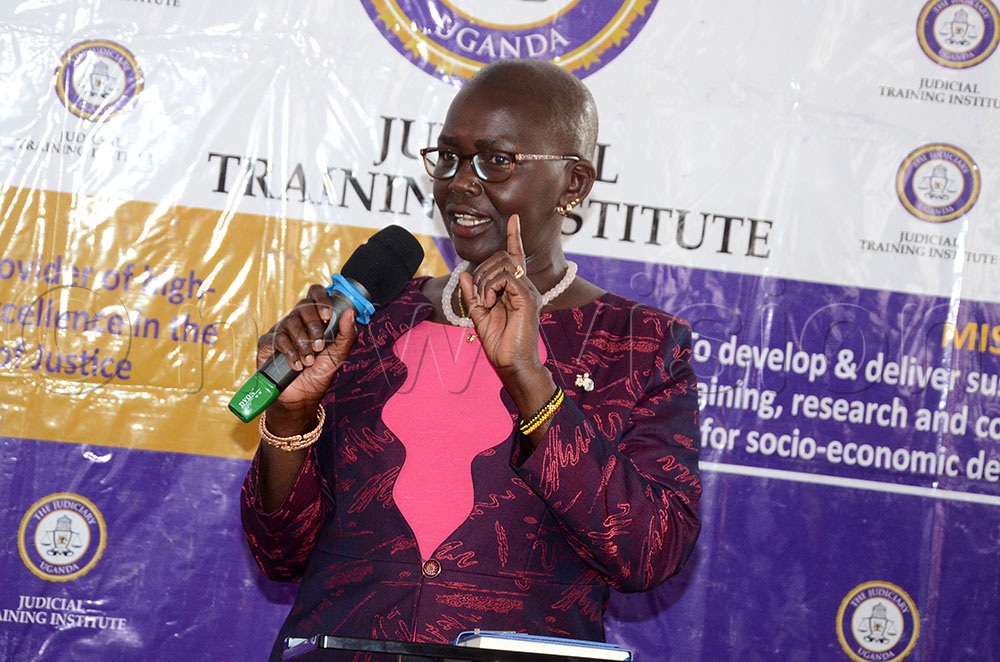
Justice Jane Francis Abodo the Principal Judge addressing during the plea bargain at magistrate’s court at the Judicial Training Institute Kampala on April 8, 2026. (Credit: Lawrence Mulondo)
'Better screening'
Ernest Nabaasa, the Officer in charge of Kampala Remand Prison, noted that since the rollout of plea bargaining in 2022, a total of 6,098 inmates have participated in the process. Of these, 1,979 were convicted and sentenced to custodial terms, representing 32 percent.
A total of 1,739 inmates received non-custodial sentences, while 298 were sentenced to time already served on remand. Another 196 were cautioned, and 21 percent were assigned community service.
Nabaasa revealed that 39 percent of enrolled inmates were not processed due to limited time, underscoring the need to expand the initiative.
“If well implemented at lower courts, plea bargaining will significantly reduce prison congestion and case backlog. We are not just dealing with numbers but with people and their lives.”
He also highlighted challenges within the prison system, including the handling of inmates with mental health conditions, many of whom are admitted without proper assessment.
“There is a need for better screening before individuals are remanded. Some inmates are not fit for custody, and this remains a major challenge,” he said.
Nabaasa proposed the creation of an integrated electronic system linking prisons, police, and the Judiciary to improve information sharing and inmate management.
'Smarter ways'
The registrar in charge of special duties, Harriet Nalukwago Ssali, explained that previously, accused persons in magistrates’ courts had to undergo full committal proceedings before their cases could be heard in the High Court.
“With plea bargaining at the magistrates’ level, this process is shortened. The accused can directly engage in negotiations with the magistrate, prosecutor, complainant, and defence."
She said courts will begin prioritising plea bargain sessions during criminal hearings, allowing willing accused persons to resolve their cases quickly before proceeding with full trials.
The Director of Public Prosecutions (DPP), Lino Anguzu, described the daily plea bargain hearings as a critical reform in the criminal justice system, noting that case backlog continues to hinder efficiency.
“When backlog persists, it undermines all our efforts. You may spend a week handling one case, yet many more remain pending."
Anguzu emphasised the need for innovation, noting that resource constraints in terms of judicial officers, prison space, and prosecutors are unlikely to ease soon.
“We must find smarter ways of working. Plea bargaining offers that opportunity,” he said, pledging full support from his office.
Prof. Andrew Khaukha, the Judicial Training Institute (JTI) executive director, revealed that within just ten days of introducing plea bargain in magistrates’ courts, 1,200 cases had already been resolved.
City Hall Court handled 361 cases, followed by Wakiso Chief Magistrate’s Court with 126 cases and Kawempe Chief Magistrate’s Court with 100 cases.
Khaukha commended the Judiciary’s leadership for supporting alternative dispute resolution initiatives, which he said are key to improving access to justice.
Wednesday's launch also saw 329 inmates from Kampala remand prison presented for plea bargain sessions before various magistrates, marking the beginning of what the officials hope will be a more efficient and humane justice system.
According to the Judiciary National Court Case Census Report 2025, more than 45,000 criminal cases are pending before the magistrates’ courts across the country.