
Japan donates sh7.7b rice towards Uganda refugee response
Despite Uganda’s progressive refugee policy, many refugees have limited livelihood opportunities and continue to depend heavily on humanitarian assistance to survive. These services, however, have been on a downward spiral for some years now, causing aid to plummet by over half of what it used to be.
World Food Programme (WFP) in Uganda on Wednesday, December 17, 2025, welcomed a contribution of 1,159 metric tons of rice valued at $2.2 million (about shillings 7.7 billion) from the Government of Japan. (Credit: WFP)
__________________
Uganda today hosts over 1.9 million refugees, the highest number on the African continent. In 2025 alone, the country welcomed nearly 145,000 newly displaced people fleeing conflict in Sudan, South Sudan and the Democratic Republic of Congo, according to UN refugee agency figures.
Despite Uganda’s progressive refugee policy, many refugees have limited livelihood opportunities and continue to depend heavily on humanitarian assistance to survive. These services, however, have been on a downward spiral for some years now, causing aid to plummet by over half of what it used to be.
One of the most pressing challenges remains food insecurity. Funding cuts, rising food prices, climate shocks and the continued influx of new arrivals have led to reduced food rations, increased hunger and growing malnutrition, particularly among children.
Against this backdrop, the United Nations World Food Programme (WFP) in Uganda on December 17, 2025, welcomed a contribution of 1,159 metric tonnes of rice valued at $2.2 million (about shillings 7.7 billion) from the Government of Japan.
The food support is expected to enable WFP to provide hot meals to newly arriving refugees at reception and transit centres across the country in 2026.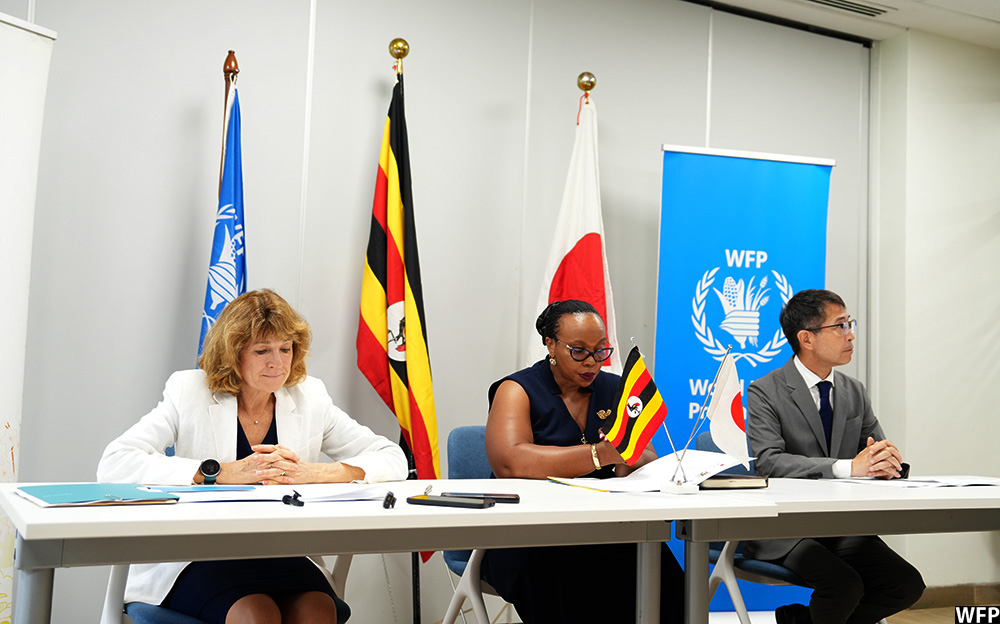
WFP Uganda Country Director Lauren Landis said the rice will be used at entry points where refugees first arrive before they are allocated land by the government. (Credit: WFP)
Japan’s Deputy Ambassador to Uganda, Norimasa Yoshida, said the contribution reflects Japan’s continued commitment to supporting humanitarian efforts in Uganda.
He noted that many refugees arrive after long and exhausting journeys, often with very few belongings, and face uncertainty in their first days in the country.
“This support will enable WFP to serve hot, nutritious meals to refugees during those critical first days at reception and transit centres,” Yoshida said.
WFP Uganda country director Lauren Landis said the rice will be used at entry points where refugees first arrive before they are allocated land by the Government.
“Before settlement, WFP provides hot meals in temporary shelters,” Landis said.
“This rice will offer much-needed energy and warmth, ensuring the most vulnerable receive dignified support at their moment of greatest need.”
The Office of the Prime Minister (OPM) also welcomed the support, recognising the importance of international partnerships in sustaining Uganda’s refugee response.
OPM permanent secretary Alex Kakooza said Japan’s contribution directly supports the stability and security of Uganda’s refugee management system under the country’s open-door policy.
Uganda’s refugee response has faced growing pressure due to funding shortfalls. In May 2025, WFP was forced to suspend food assistance to one million refugees and drastically reduce rations for another 700,000.
Japan’s contribution directly supports the stability and security of Uganda’s refugee management system under the country’s open-door policy. (Credit: WFP)
While targeted food assistance has helped reduce food insecurity among those still receiving support, severe hunger has increased among households that are no longer assisted.
WFP estimates it will require an additional $48 million for food assistance in 2026, making contributions such as Japan’s critical for sustaining lifesaving support.
Japan has been a long-standing partner of WFP Uganda, providing more than $10 million in humanitarian support over the past five years to help respond to emerging refugee crises.