
Call for more white canes as blind Ugandans face mobility crisis
“To us, visual impairment is an expensive disability,” Mugume said. The burden, he added, is even greater for learners, who require costly assistive machines and learning materials that the government does not provide in sufficient quantities.
John Byarugaba, Lions Club International District Governor, hands over a white cane to a pupil. (Photo by Ritah Mukasa)
________________
“Some people blame us for causing our blindness. Others attribute it to the sins of our parents. Stigma is real, and such allegations are hurtful,” said Amon Mugume, treasurer of the Uganda National Association of the Blind (UNAB).
Mugume noted that life can be particularly difficult for people with visual impairments, both young and old, with stigma often compounded by mobility challenges. Many cannot afford basic mobility aids such as white canes, leaving them more vulnerable and less able to move independently.
“To us, visual impairment is an expensive disability,” Mugume said. The burden, he added, is even greater for learners, who require costly assistive machines and learning materials that the government does not provide in sufficient quantities.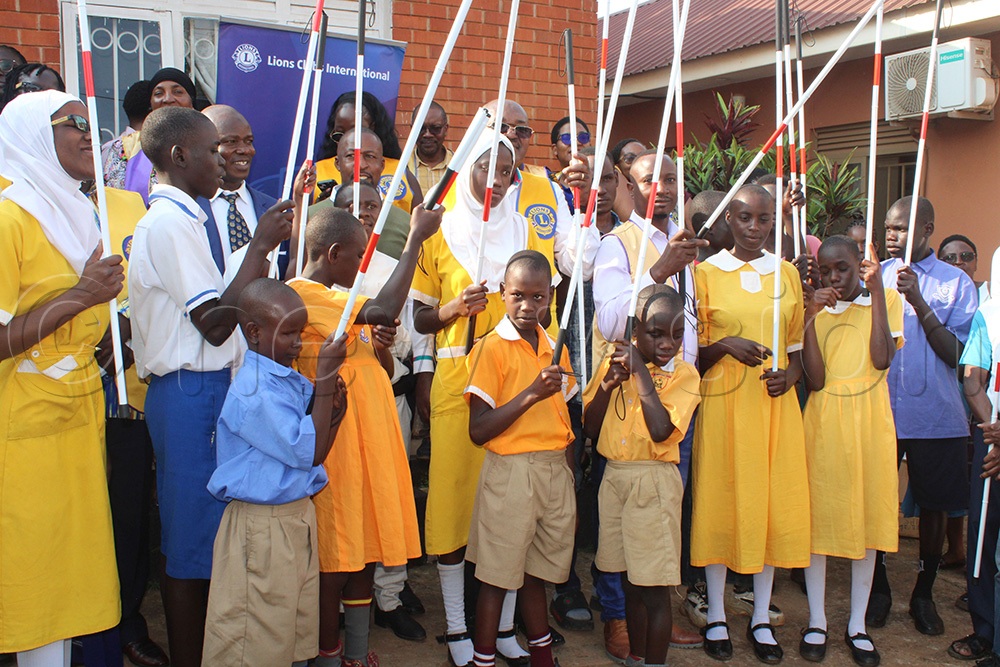
Three schools are among the recipients of the white canes donated by the Lions Club of Kampala East. (Photo by Ritah Mukasa)
Some children are also abandoned at school by their parents, while the shortage of special-needs teachers further limits their access to quality education.
Mugume made the remarks on Friday, August 21, during an event at the UNAB offices along Kireka-Namugongo Road in Wakiso District, where the association received 100 white canes donated by the Lions Club of Kampala East.
Some of the canes were handed to 25 learners from three schools: Sir Apollo Kaggwa School, Salaama School for the Blind and Bukoto Islamic School.
“A person with vision might disregard this cane as something minor. But to a blind person, it is their lifeline,” Tumwebaze said.
A white cane is an essential mobility and navigation tool that enables people with visual impairments to move safely and independently. It helps users detect obstacles, stairs and changes in surfaces, while also signalling to members of the public that the person has a visual impairment.
According to Tumwebaze, white canes cost between Shs75,000 and Shs1.5 million, depending on the type and where they are purchased.
“We have been able to develop a register for visually impaired persons across the country,” he said, adding that through district structures, the association has so far registered more than three million people with visual impairments, including people who are blind and those with low vision, across 110 districts.
He thanked the Lions Club for the donation, saying the canes would enable visually impaired students, young people and older persons to navigate their surroundings more safely and live more independently. The mobility aids would also allow them to participate more fully in socio-economic activities such as farming and business.
Tumwebaze said the white cane is a recognised mobility aid under road and traffic laws, meaning motorists and pedestrians are required to exercise caution and respect when they encounter someone using one.
Dorothy Ssebadduka, head teacher of Salaama School for the Blind in Mukono District, said the canes would make it easier for learners to move around and participate in school activities.
Mugume also called on the public to join UNAB in commemorating World White Cane Day on October 15 in Koboko District.
Speaking during the handover, John Kikanu Byarugaba, Lions Clubs International District Governor 411B, thanked UNAB for mobilising and supporting people with visual impairments across the country.
He traced the Lions’ involvement in supporting people with visual impairments to 1925, when Helen Keller challenged members of the organisation to become “Knights of the Blind”.
He commended the Lions Club of Kampala East for responding to that call by donating the 100 white canes.
“As Lions, we believe that service should make a practical difference in the lives of the people who are supposed to be impacted,” Byarugaba said.
Meanwhile, according to the 2024 Uganda Bureau of Statistics (UBOS) National Population and Housing Census, more than 5.5 million Ugandans have disabilities, accounting for 13.2 per cent of the national population. Of these, 28,843 were recorded as completely blind.
However, stakeholders, particularly UNAB, estimate that the number of people living with visual impairments is much higher, with more than three million people affected.
Cataracts, uncorrected refractive errors, glaucoma and blinding trachoma are among the major causes of visual impairment and blindness in Uganda.