
Why do Ugandans still die of malaria?
Uganda was ranked third in contributing malaria cases. Globally, a total of 282 malaria cases were estimated in 80 malaria-endemic countries in 2024.
Susan Achom, a Village Health Team member of Kalaki village, Kaicho subcounty, checks the body temperature of a sick child. (Credit: Agnes Kyotalengerire)
Malaria remains one of the leading causes of illness and death in Uganda, accounting for an estimated 30% - 50% of outpatient visits and a significant share of hospital admissions.
It continues to disproportionately affect children under five and pregnant women, placing a heavy burden on families and the health system.
As Uganda marks World Malaria Day (April 25), the national theme “Zero Malaria Deaths” sends a clear message that no Ugandan should die from a disease that is both preventable and treatable.
Aubrey Agaba, who is the malaria-free country coordinator, said Iganga district was chosen to host the national World Malaria Day commemorations because of its intense malaria transmission, high prevalence among children under five, and elevated positivity during peak seasons.
Uganda was ranked third in contributing malaria cases. Globally, a total of 282 malaria cases were estimated in 80 malaria-endemic countries in 2024.
Of those, Uganda contributed 13,216,000, hence ranking 3rd and trailing the Democratic Republic of the Congo with 35,175,000 cases and Nigeria with 68,466,000 cases.
The Uganda Malaria Indicator Survey 2024/2025 (UMIS) reveals that malaria prevalence among children aged between 6 and 59 months increased from 10 percent in 2018/2019 to 13 percent in 2024/2025, according to the Uganda Malaria Indicator Survey 2024/2025 (UMIS), consequently reversing gains recorded over the past decade.
The malaria prevalence among children aged 6–59 months had previously dropped significantly from 45 percent in 2009 to 20 percent in 2014/2015 before declining further to 10 percent in 2 sub-regions.
The Lango subregion recorded 32 percent, followed by Karamoja with 26 percent, hence recording the highest malaria prevalence rates among children aged between 6 and 59 months.
Meanwhile, Kampala and Kigezi recorded the lowest prevalence at less than 1 percent. Although malaria deaths have been declining since 2016, the current trajectory did not meet the 75% mortality reduction target by 2025.
In 2024, Uganda ranked 9th in contributing to global malaria mortality with 2,780 deaths, which translates into 2.7%. Of these, 82% of the deaths occurred in children under the age of five.
Busoga, West Nile, Acholi, Karamoja, and Lango carry the highest burden. It is important to note that the burden is shifting to older children and adults.
“Every malaria death points to a failure in the health system; malaria is both preventable and treatable,” said the deputy program manager, Dr. Catherine Maiteki.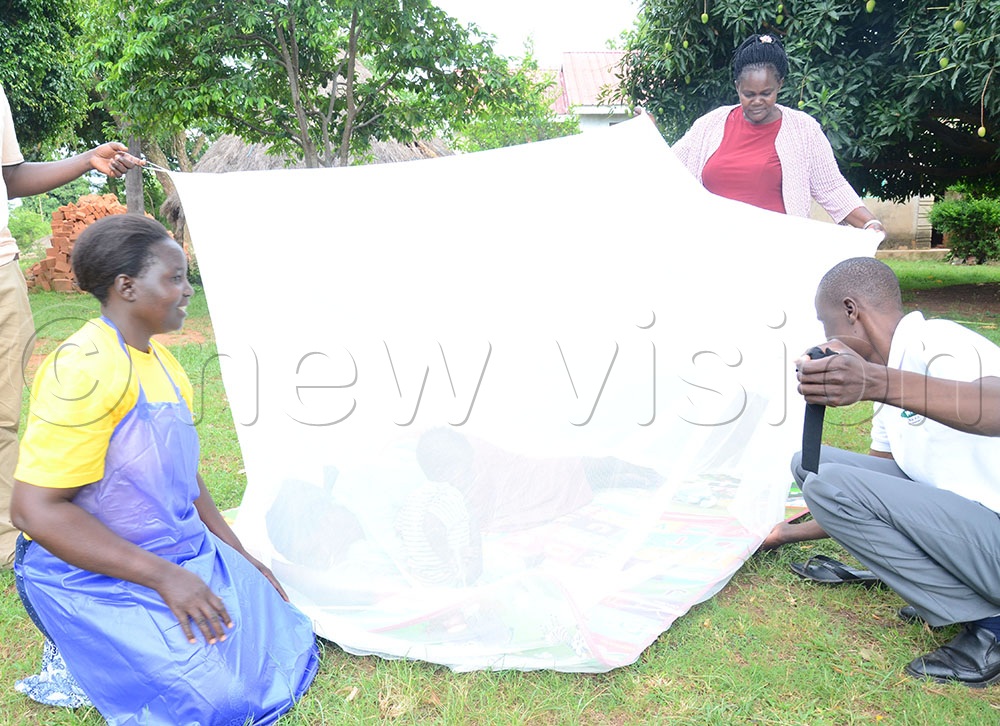
Susan Achom, a Village Health Team member of Kalaki village, Kaicho subcounty, demonstrates how to use a treated mosquito net. (Credit: Agnes Kyotalengerire)
Death drivers
Maiteki attributed the deaths to delay in seeking care, noting that people report to health facilities 24 hours after the onset of the fever, which increases progression to severe malaria by fivefold. Social norms, self-treatment with herbs, and visits to non-qualified providers also cause critical delays.
Referral completion rates are extremely low due to transport costs, long distances, poor health service provider attitudes, and lack of family support, and this results in severe cases being untreated.
Highlighting funding and governance gaps, Maiteki said over-reliance on donor funding, insufficient district prioritisation of malaria, and weak accountability mechanisms limit sustained implementation.
Not to mention, a weak health system with frequent drug stock-outs and inappropriate case management where drug shops dispense substandard or incomplete doses. False-negative rapid diagnostic tests (RDTs), missed diagnoses, and poor IV artesunate compliance compound risk at facilities.
Impact beyond health
The government spent $560 million (sh 2.082 trillion) in 2021 (roughly 1.4% of Uganda’s GDP) on malaria treatment. Households bear more than 40% costs while struggling to sustain their livelihoods.
Maiteki said the government spends 27% of the Catastrophic Health Expenditure (CHE) on malaria treatment. This makes malaria not just a public health issue but also a serious economic challenge that affects national growth and business performance.
She said that while Uganda has made progress in prevention and treatment, gaps in implementation and financing remain. Apparently, recent reductions in external donor support have increased the urgency for stronger domestic investment and local solutions.
The Government of Uganda, through the national malaria elimination strategy, has set an ambitious target to reduce malaria cases by at least 75% of 2024 levels and achieve zero malaria deaths by 2030.
Agaba said Uganda must adopt a whole-of-society approach where government, the private sector, and communities work together to accelerate malaria elimination.
Businesses, in particular, have a critical role to play by investing in prevention and protecting their workforce.
At the community level, simple actions like sleeping under mosquito nets, testing early, and seeking prompt treatment can save lives. Zero malaria deaths is achievable. But it will require urgent action, stronger partnerships, and sustained commitment from all sectors, Agaba noted.
Needed interventions
• Implement behaviour change techniques (BCTs) to promote care-seeking within 24 hours of fever onset
• Empower community health extension workers (CHWs) with job aids and communication tools to reach vulnerable households
• Launch sensitisation campaigns for previously low-risk populations (urban, older adults)
• Integrate 'Act Fast, Save Life' messaging into malaria vaccine rollout platforms
• Target boarding schools, prisons, and hospitals as high-risk institutional settings
• Strictly regulate drug shops—enforce NDA ban on antimalarial OTC dispensing