
'I had accepted death': Historic bone marrow patient hails Ugandan doctors
Sande has now become the first Ugandan to successfully undergo a bone marrow transplant performed entirely by Ugandan doctors at the Uganda Cancer Institute (UCI).After 22 days in intensive isolation, he walked out of the hospital alive, marking a historic turning point in the country’s specialised cancer care.
Sande commended the government of Uganda and President Yoweri Museveni for his support towards specialised treatment and urged Ugandans to trust Ugandan doctors. (Credit: Maria Wamala)
KAMPALA - For 45-year-old Steven Sande, a URA staff member from Namayingo in eastern Uganda, life had already started slipping away. Weak, bedridden, and unable to stand without help, he had quietly prepared himself for death — until a team of Ugandan doctors offered him something he no longer believed was possible: a second chance at life.
Sande has now become the first Ugandan to successfully undergo a bone marrow transplant performed entirely by Ugandan doctors at the Uganda Cancer Institute (UCI).
After 22 days in intensive isolation, he walked out of the hospital alive, marking a historic turning point in the country’s specialised cancer care.
“I had already accepted death. My mind was telling me I was going to die. But Dr [Clement] Okello and Dr Okuku told me I could still live. I can say they are my second gods. It’s like I have paid a bank loan. I am a poor man. Where would I have gotten that money?” Sande said during his discharge on Friday.
He said his journey from bed to recovery felt almost impossible. And when asked whether he understood the risks, Sande did not hesitate.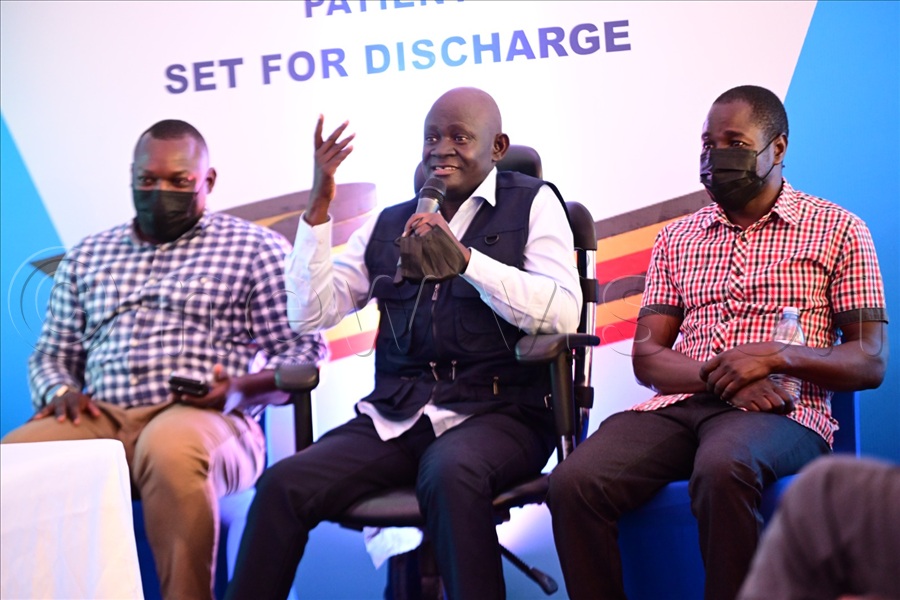
According to health experts at UCI, Sande's survival is not just personal; it signals Uganda’s entry into a new era of high-level cancer treatment. (All Photos by Maria Wamala)
“They told me anything could happen. But I had already decided I would try. I said if I die, I die trying. I trusted them. Dr Okuku took me from the bed to the wheelchair, and from the wheelchair to walking again. I thought I would not make it, so I trusted them, having seen where I had come from."
Sande commended the government of Uganda and President Yoweri Museveni for his support towards specialised treatment and urged Ugandans to trust Ugandan doctors.
He was diagnosed in 2025 with multiple myeloma, a cancer of the blood plasma cells.
His condition had started quietly with persistent back pain, joint aches and losing weight, before rapidly worsening, leaving him unable to work and forcing him to fully depend on caregivers.
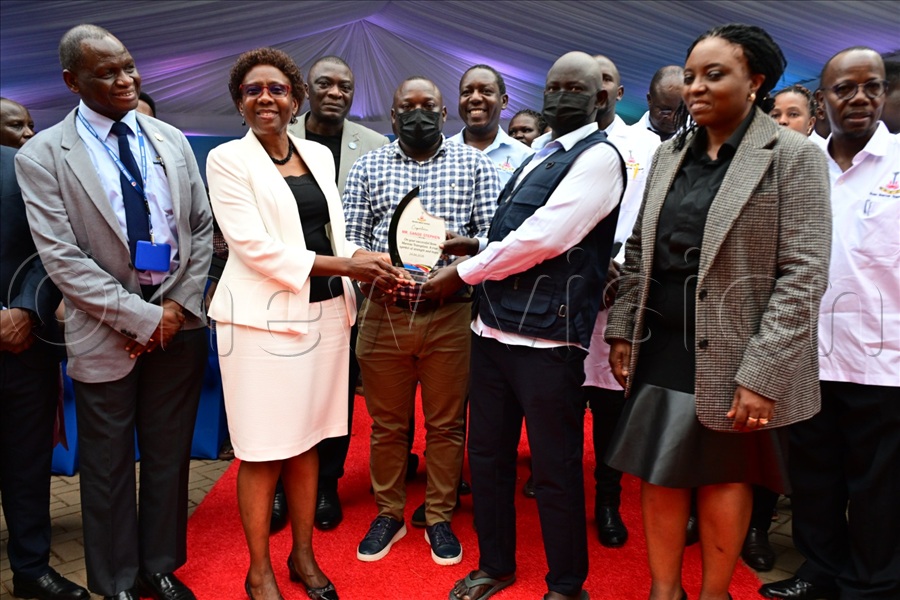
Health minister Ruth Aceng hands over a congratulatory pleque of courage, strength and hope to the first bone marrow transplant patient, Stephen Sande, upon his discharge from Uganda Cancer Institute.
Multiple myeloma is a blood cancer affecting plasma cells in bone marrow, weakening immunity and damaging bones and kidneys. It causes bone pain, fatigue, infections, and fractures. Although its cause is unclear, it is linked to age and genetics.
Treatment includes chemotherapy and bone marrow transplant to prolong life.
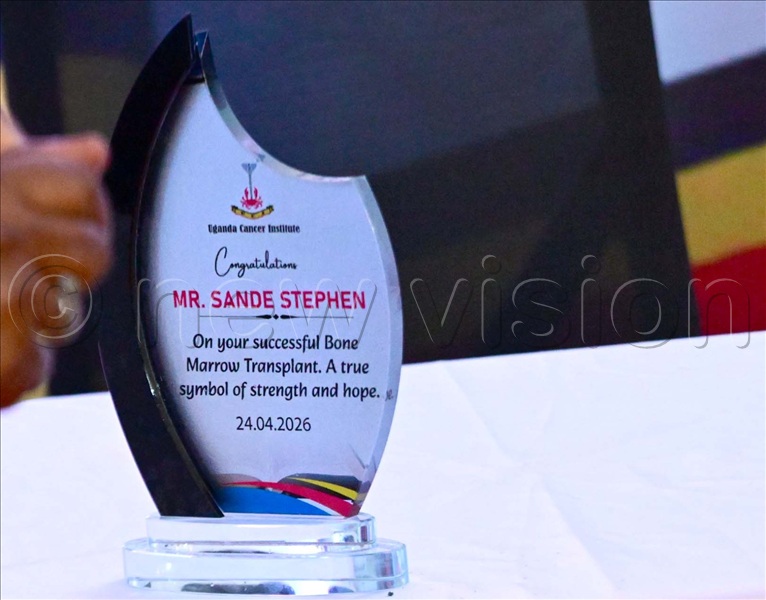
Doctors at UCI later confirmed Sande was an ideal candidate for an autologous stem cell transplant after responding well to initial treatment and showing no major complications. He underwent the procedure earlier this month and was discharged on April 24 in stable condition after 22 days.
The government fully covered the entire cost.
The procedure, known as autologous stem cell transplantation, is considered the global standard for eligible multiple myeloma patients. It involves harvesting a patient’s own stem cells, administering high-dose chemotherapy to wipe out diseased and healthy cells, and reinfusing the stored cells to rebuild the bone marrow.
According to health experts at UCI, Sande's survival is not just personal; it signals Uganda’s entry into a new era of high-level cancer treatment.
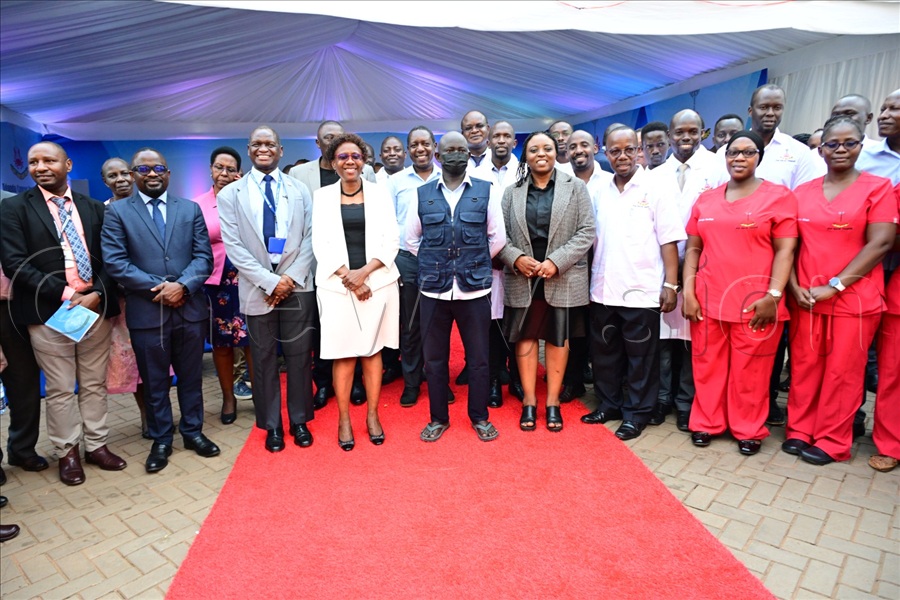
'Historic day'
For years, patients requiring bone marrow transplants were referred abroad, mainly to India, South Africa, or Europe, at costs ranging between $30,000 (sh112 million) and $50,000 (sh186 million), excluding travel, accommodation, and logistics.
At UCI, however, Sande’s government-funded treatment cost about $15,000 (sh55 million).
Health minister Dr Jane Ruth Aceng, who officiated his discharge, said this represents a deliberate shift in reducing medical evacuation abroad and promised that the government intends to provide such services at lower cost compared to what is charged abroad.
“This is a historic day. Ugandans are proving they can deliver advanced treatment here at home at a fraction of the cost. The first five to ten patients will be fully covered by government, and thereafter, the cost will remain around $15,000," she said.
Behind the breakthrough is Dr Okello, the transplant team lead who has worked for nearly a decade to establish the programme. He said the journey was long, uncertain, and often stalled by lack of support.
“We started in 2017 with an idea. We had trained, we had hope, but we lacked stability. At one point, support collapsed, and everything slowed down. But we never stopped believing Uganda could do this,” he said.
Momentum returned in 2023 after government funding strengthened the programme. A dedicated transplant committee was formed, protocols were written, and training intensified, including one in India with the whole team, setting the stage for Uganda’s first successful transplant.
Sande was eventually selected in December 2025 after careful screening. He was medically stable, in remission, and strong enough to tolerate the procedure, making him the ideal first case.
Okello likened the process to farming.
“We cleared everything in his body like a garden. Then we replanted his own healthy cells so the body could grow again from zero. It is like starting life anew.”
After chemotherapy wiped out his immune system, Sande was placed in a sterile isolation unit where even minor infections could have been fatal. His body was completely fragile and required constant monitoring.
At one point, he developed a high fever that caused alarm among the medical team.
“We feared infection. But it turned out to be engraftment syndrome, the moment the new cells started growing. That was when we knew it was working.”
His recovery took 22 days, during which his body gradually began producing healthy blood cells again. Doctors confirmed successful engraftment before discharging him.
He has now been instructed to avoid crowds, wear a mask at all times, and maintain strict hygiene. Over the next six months, he will undergo full revaccination, similar to a newborn child, since his immune system has essentially been reset.
Despite the success, doctors emphasised that Sande is not fully cured. Multiple myeloma is a chronic disease that can return, though the transplant significantly delays progression and improves survival.
“What we have done is push the disease far into the future. It may come back in 20 years or more, or it may not. But right now, he has regained life,” said Okello.
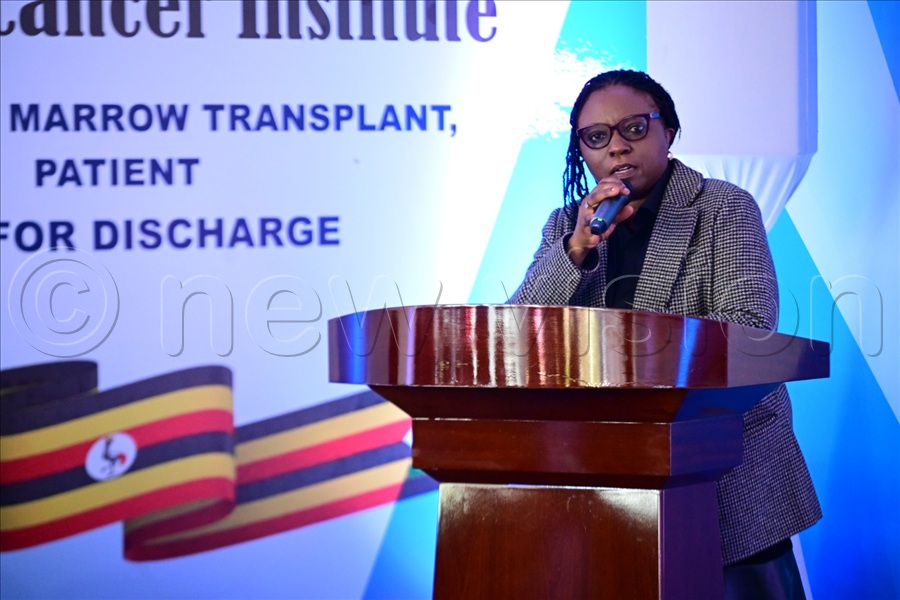
Uganda Cancer Institute Board Chairperson Prof. Damalie Nakanjako
'We are moving carefully'
Dr Henry Ddungu, head of the transplant department, said demand is already high, with an estimated 50 patients annually requiring bone marrow transplants, especially for blood cancers such as multiple myeloma and lymphomas.
However, capacity remains limited. The unit currently operates with only one transplant bed, meaning only one patient can be treated at a time, with each procedure taking up to 30 days.
“We are moving carefully. This is highly specialised care. But the need is far greater than what we can currently handle,” said Ddungu.
He said plans are underway to expand services to include leukemia and eventually sickle cell disease, which requires donor-based transplants. With adequate funding, the team believes they can perform at least five transplants this year.
Dr Jackson Orem, the executive director of UCI, said the milestone reflects a broader national ambition and local treatment could save millions of dollars previously spent on overseas care while strengthening Uganda’s medical independence.
“This is medical sovereignty. We are proving that Uganda can solve its most complex health challenges,” he said.