
Busoga youths to benefit from sh60 billion empowerment programme
At the signing ceremony in Kampala on July 23, UNFPA Representative in Uganda Kristine Blokhus said the Netherlands' contribution would significantly strengthen efforts to empower Uganda's youthful population.
UNFPA's Kristine Blokhus exchanges signed documents with the Chargé d'Affaires at the Embassy of the Kingdom of the Netherlands, Bouwe-Jan Smeding. (Photos by John Musenze)
________________
Hundreds of youths, including adolescents in Busoga, are set to benefit from a new sh60 billion (US$16 million) empowerment program aimed at reducing teenage pregnancies, improving access to sexual and reproductive health services, preventing gender-based violence and equipping young people with life skills.
The funding follows the Netherlands' decision to join Denmark, Sweden and Iceland in supporting the Strengthening Adolescents and Youth Rights and Empowerment (SAY Plus+) program, a multi-donor initiative implemented by the United Nations Population Fund (UNFPA) in partnership with the Government of Uganda.
The four-year program will initially focus on: Namutumba, Buyende, Namayingo and Mayuge districts where high rates of teenage pregnancy, early motherhood, school dropouts and gender-based violence continue to undermine the wellbeing and future prospects of young people.
At the signing ceremony in Kampala on July 23, UNFPA Representative in Uganda Kristine Blokhus said the Netherlands' contribution would significantly strengthen efforts to empower Uganda's youthful population.
"As UNFPA, we are thrilled that the Kingdom of the Netherlands has joined the SAY Plus+ initiative alongside Denmark, Sweden and Iceland with a US$16 million investment. Uganda's youth make up 73% of the population under the age of 30, and this initiative seeks to unlock the country's economic potential by investing in their sexual and reproductive health and rights," Blokhus said.
During the events hosted at her offices, she noted that Uganda is at a critical demographic moment where investing in young people could accelerate economic growth but warned that persistent barriers such as teenage pregnancy, gender-based violence and limited access to reproductive health services continue to derail that potential.
According to UNFPA, nearly 24% of Ugandan teenage girls become pregnant each year, which is equivalent to about 1,000 girls every day, forcing many to abandon school and limiting their future opportunities.
"An unplanned pregnancy, gender-based violence or an unmanaged health condition can abruptly halt a young person's educational and professional path. When adolescent girls cannot complete school, it is not only a personal tragedy but also a loss for the country's development," Blokhus said.
officials from UNFPA, Dutch Embassy and other dignitaries pose for a photo after the official signing.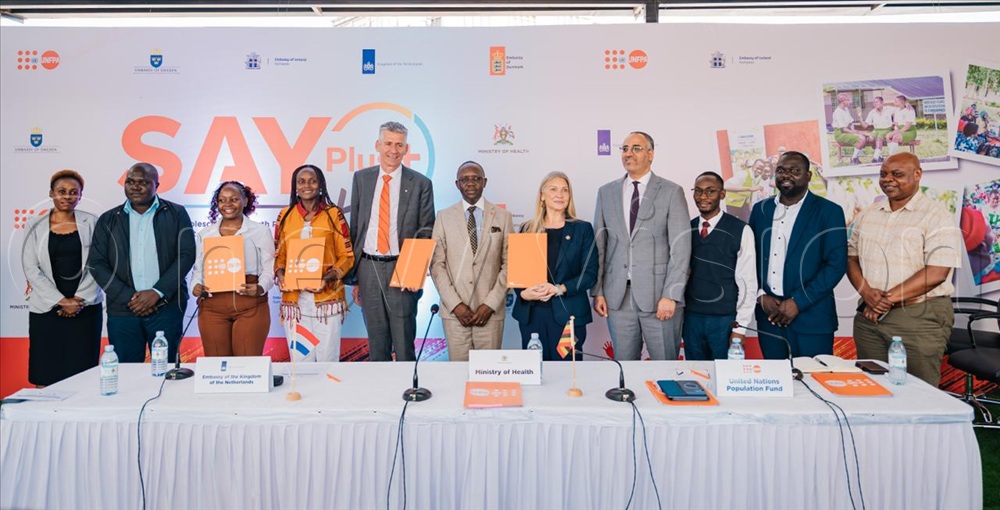
She said the programme will strengthen youth-friendly health services, provide comprehensive sexuality education and life skills, improve HIV prevention services and work with families, community leaders and cultural institutions to tackle harmful social norms, child marriage and gender-based violence.
Blokhus also announced the establishment of a Youth Advisory Committee to ensure young people actively participate in designing, implementing and monitoring programs intended to serve them.
"We believe in the principle of 'Nothing for us without us.' Young people must be co-architects of programs that affect their lives," she said.
The Chargé d'Affaires at the Embassy of the Kingdom of the Netherlands, Bouwe-Jan Smeding, said his country decided to support the initiative because of the urgent need to reverse stagnant indicators on teenage pregnancy and reproductive health.
He noted that although Uganda has received donor support over the years, teenage pregnancy has remained at around 24% since 2006, while child marriage remains widespread.
"We have moved beyond counting activities like workshops and trainings. We want to see measurable outcomes. Funding should lead to real change in people's lives," Smeding said.
He, however, stressed that interventions in Uganda should remain culturally appropriate while remaining evidence-based.
"We cannot allow global backlash against sexual and reproductive health and rights to undermine the health and future of girls and women. We must ensure our interventions are evidence-based and culturally sensitive," he said.
Representing the Ministry of Health, director of public health Dr Daniel Kyabayinze welcomed the funding, describing it as a major investment in Uganda's human capital. He said the Ministry would work closely with district health teams to upgrade health facilities, integrate HIV, gender-based violence and reproductive health services, and train health workers to provide respectful and youth-friendly care.
"We are particularly pleased that this investment is focused on Busoga, where young people face significant challenges including adolescent pregnancy, school disruption and gender-related risks," Kyabayinze said.
He added that protecting the health of adolescents is central to Uganda's ambition of achieving long-term socio-economic transformation.
"When a 14 or 15-year-old girl becomes pregnant, her education stops, her health is threatened, and her economic future is compromised. By helping young people delay childbearing and make informed choices, we preserve their opportunity to complete school, gain skills and contribute to Uganda's economy," he said.
Kyabayinze assured development partners that the government would provide strategic oversight to ensure the investment delivers measurable results and pledged to gradually integrate successful interventions into government systems for long-term sustainability.
The SAY Plus+ program targets adolescents and young people aged between 10 and 24 years, with particular attention to adolescent girls, young women, out-of-school youth and refugees.
Beyond improving access to reproductive health services, the program also aims to strengthen protection against gender-based violence, increase community engagement to challenge harmful cultural practices, and build stronger health systems capable of delivering integrated youth-friendly services.