
'Men fear to report they were beaten by a woman'
According to Paul Nkoreganda, the commissioner for political education in the Uganda Police Force, every victim needs to report because GBV is a crime.
Commissioner Paul Nkoreganda (left), head of the political and education department at Uganda Police Force, presents a certificate to Elly Ecewatu, a police trainer at the Senior Police Staff College, Bwebajja, after a gender-based violence (GBV) course organised by the Centre for Domestic Violence Prevention (CEDOVIP) in Kampala on August 4, 2026. The course was attended by 31 police officers. Looking on are Josephine Kamisya (second right), Executive Director of CEDOVIP, and Maureen Atuhaire, Acting Commissioner of the Child and Family Protection Department. (Photo by Wilfred Sanya)
________________ A cross-section of police officers attend a training organised by the Centre for Domestic Violence Prevention (CEDOVIP) on handling gender-based violence (GBV) in Kampala on August 5, 2026. (Photo by Wilfred Sanya)
While most female victims of gender-based violence (GBV) will report to authorities, many male sufferers of the same, for various reasons, instead hold back and struggle silently.
Yet, according to Paul Nkoreganda, the commissioner for political education in the Uganda Police Force, every victim needs to report because GBV is a crime.
"Men fear to say they were beaten by a woman, yet women come out to speak and report the cases," he said.
GBV, which is a violation of human rights, takes many forms: from physical and sexual to psychological and economic.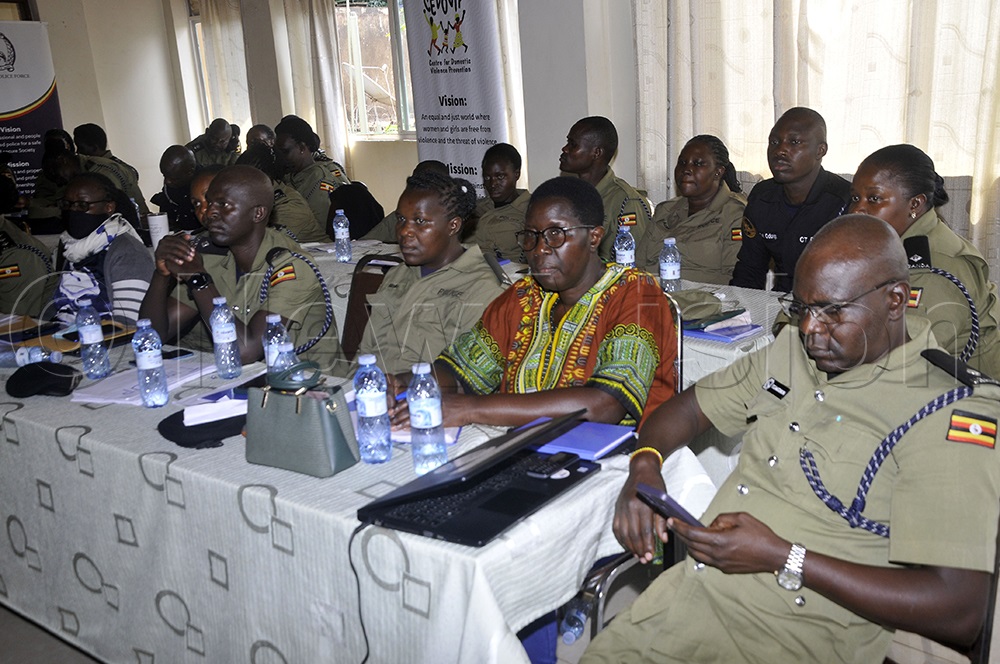
During a training session for police officers in Kampala this week, Nkoreganda spoke of the need to get to the root causes of GBV to achieve lasting solutions to the vice.
The aim of the August 4 workshop organised by Centre for Domestic Violence Prevention (CEDOVIP) in partnership with the Uganda Police Force was to enhance the police's responsiveness to GBV.
Typically, GBV refers to any act of violence that is directed against an individual based on their gender identity or perceived gender.
It means anyone can be a victim. Even police officers themselves, according to Nkoreganda.
Usually, victims report to authorities, including the Police, in the hope of getting protection. But Nkoreganda said in some cases, police officers instead of helping, turn into tormentors of victims.
"With the training you have had, we expect you to teach your fellow police officers how to handle GBV cases professionally," he said.
Experience is also important.
“We need to see that we deploy special police constables and community liaison land officers with experience to handle certain matters. You cannot get somebody of 19 or 20 years of age to handle me who has been in police for such a long time."
The Police Crime Report of 2025 showed that a total of 12,361 domestic violence cases were reported nationwide in 2025.
Although it was a decline from the 14,073 cases reported in 2024, females continued to bear the overwhelming burden of this violence.
Murders arising from domestic violence rose by 13.7% from 183 cases in 2024 to 208 in 2025, with 92 female adults among the victims.
Josephine Kamisya, the executive director of CEDOVIP, said many more cases of gender-based violence remain unreported every year.
“As we talk about GBV, some of us are victims of the perpetrators, and what we are discussing might be happening in our daily lives," she told the workshop of police officers.
"Be fair to yourself by protecting the lives of others by enforcing the law among the perpetrators."
Kamisya said it is a shame that some victims of GBV who report cases are advised by ignorant police officers to return home and sort out their issues with their partners or have relatives intervene.
Police trainer Elly Ecewatu said training more officers will see GBV cases handled much better and more professionally.