
NRM says education remains cornerstone, pledges increased investment
“Plans are underway to recruit 2,294 teachers for 74 schools for FY 2025/26. The Government has provided 27.2 billion for ICT equipment, 13.6 billion for science kits, and 2.48 billion for science reagents. This investment covers all computer and science laboratories for all the 259 Seed Schools in the UgIFT programs,” Muyingo added.
Addressing journalists at the party secretariat in Nakasero, Kampala, on November 21, 2026, alongside the party’s deputy secretary general Rose Namayanja Nsereko, Muyingo reminded the country that the NRM entered this term with a clear resolve to strengthen education and sports as engines of social transformation and economic competitiveness. (Credit: Ronnie Kijjambu)
KAMPALA - As the country enters the final stretch of campaigns leading to the 2026 General Election, the National Resistance Movement (NRM) party has renewed its message that education remains the cornerstone of Uganda’s transformation.
In a reflective address on the party’s 2021-2026 commitments, higher education state minister Dr John Chrysostom Muyingo affirmed that the Government’s sustained investment in education and sports is steadily reshaping the nation’s human capital, calling the progress “evidence that the country’s long-term development is attached in deliberate planning and consistent delivery.”
Addressing journalists at the party secretariat in Nakasero, Kampala, on November 21, 2026, alongside the party’s deputy secretary general Rose Namayanja Nsereko, Muyingo reminded the country that the NRM entered this term with a clear resolve to strengthen education and sports as engines of social transformation and economic competitiveness.
He highlighted the milestone of expanding secondary education, noting that the construction of 259 new schools under the Uganda Intergovernmental Fiscal Transfers (UgIFT) programme project had surpassed the initial target of 258 schools.
Many of these schools are already operational, while others are set for commissioning, a development he said was aimed at equitable access for every Ugandan child.
He explained that 115 out of 117 schools under phase one are fully functional, while 75 under phase two await commissioning, and three more under phase three are also ready for commissioning.
He noted that the ministry is also taking on a more ambitious agenda through the Uganda Secondary Education Expansion project, which includes constructing 116 new secondary schools and rehabilitating 61 in refugee-hosting communities.
He revealed that construction has already begun in districts such as Kazo, Namayingo, Kamwenge, Mitooma, Ibanda and Namutumba.
Commitment to expanding schools
The minister also highlighted the Government’s commitment to upgrading and expanding 121 traditional secondary schools, 66 Special Needs Education institutions, and 22 Teacher Training Institutions under Uganda Learning Acceleration Program (ULEARN), including the National Institute for Teacher Education.
He noted a significant investment in instructional materials, shillings 42.14 billion for secondary schools and 28.15 billion for primary schools, alongside the recruitment of over 10,000 teachers and more than 2,600 support staff for newly established seed schools.
“Plans are underway to recruit 2,294 teachers for 74 schools for FY 2025/26. The Government has provided 27.2 billion for ICT equipment, 13.6 billion for science kits, and 2.48 billion for science reagents. This investment covers all computer and science laboratories for all the 259 Seed Schools in the UgIFT programs,” he added.
Muyingo emphasised that the NRM’s progress is not only about expanding access but also elevating the quality of education.
He pointed to enhanced teacher welfare, mandatory inclusion of staff housing in new schools, and a strengthened inspection system backed by shillings 37.51 billion in government funding.
He noted that the recruitment of 448 additional inspectors helped Uganda achieve the international inspector-to-school ratio of 1:40, while the rollout of the Integrated Inspection System in 2023 introduced real-time monitoring through the Teacher Effectiveness and Learner Achievement (TELA) and Electronic Inspection (E-Inspection) system, which tracks both teacher performance and learner progress in real time.
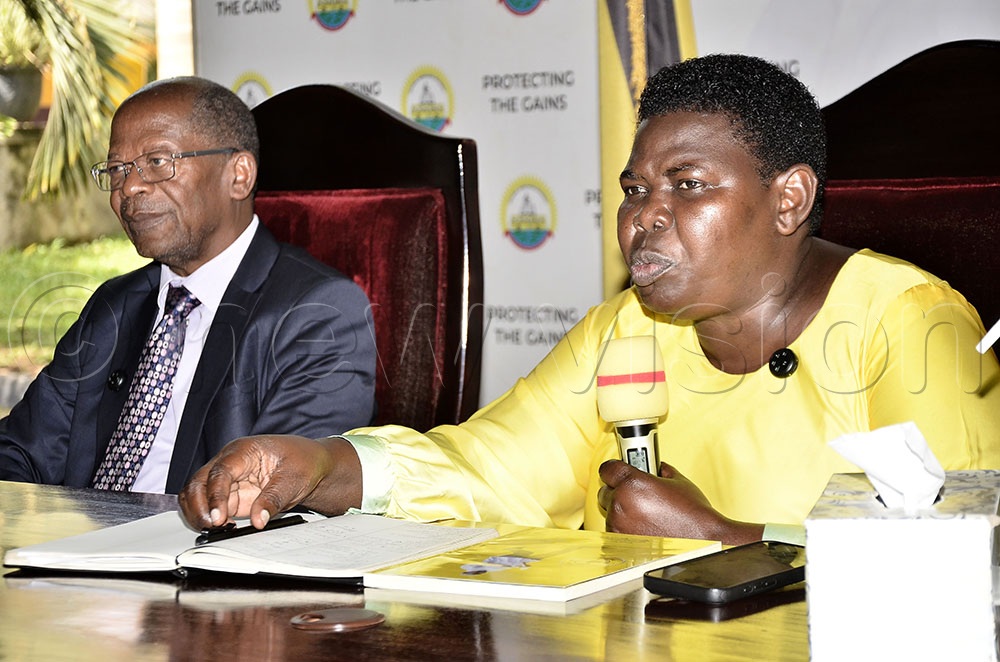
Namayanja lauded the NRM’s sustained efforts and said the party has begun highlighting its commitments for Ugandans to appreciate the gains achieved over many years. (Credit: Ronnie Kijjambu)
He noted that this technology has already “boosted teacher attendance and strengthened accountability,” making school management more transparent and data-driven.
The minister outlined reforms aligned to global standards, competency-based curricula, practical skills training, and revitalised A-Level content, meant to prepare learners not merely for examinations but for innovation and productivity in a competitive economy.
He described the transformation of TVET institutions as one of the NRM’s proudest achievements, citing the state-of-the-art facilities, modern equipment and centres of excellence in fields like agriculture, petroleum, construction and manufacturing, saying they have “turned vocational colleges into engines of real productivity.”
Over the past four years, the government has awarded 24,985 scholarships to students pursuing undergraduate degrees and diplomas in Science, Technology, Engineering and Mathematics (STEM)/Innovations (STEI) and other market-relevant programmes.
A total of 8,451 learners have benefited from the Higher Education Students Financing Scheme (Loan) to access quality education.
Muyingo celebrated progress in revitalising public universities, including Busoga University and Mountains of the Moon University, and the groundwork for a new institution in Bunyoro, reaffirming that no capable learner should be held back because of financial constraints.
He reminded the country that at the time when NRM assumed leadership, Uganda had only one public university, yet today the nation boasts of ten, with two additional institutions already in the pipeline.
In sports, the minister pointed to national preparations for CHAN 2025 and AFCON 2027 as catalysts for renovating Mandela National Stadium and upgrading regional stadiums in Hoima and Lira.
He noted that improvements in training facilities in schools and universities reflect “a renewed national pride in sports excellence.”
Muyingo also recognised advancements in inclusive education, including expanded vocational spaces, upgraded facilities for learners with hearing impairments and improved environments to ensure no child is left behind.
Namayanja lauded the NRM’s sustained efforts and said the party has begun highlighting its commitments for Ugandans to appreciate the gains achieved over many years.
She expressed confidence that the progress registered in education and sports is laying the foundation for a modern, knowledge-driven nation and underscored that Uganda’s future depends on ensuring that “every learner is empowered to grow, compete, innovate and succeed” to contribute to the development of their country.
She announced that the NRM will be holding weekly updates on its manifesto achievements, beginning with the transformative journey in the education and sports sector.