
Museveni says skilling hubs instrumental in poverty eradication
The President say the hubs are important, especially for the youth from poor families who did not get a chance to attain education elsewhere.
President Yoweri Museveni said skilling hubs have two purposes. One is to create wealth. Wealth comes from people (PPU photos)
________________
President Yoweri Museveni says skilling hubs are instrumental in eradicating poverty from Uganda's households.
The President say the hubs are important, especially for the youth from poor families who did not get a chance to attain education elsewhere.
According to him, Uganda’s true path to liberation lies not just in politics but also in technology, skills and practical education.
“Skilling hubs have two purposes. One is to create wealth. Wealth comes from people,” he says.
Museveni made the remarks on May 13, 2025, while launching the Presidential Zonal Industrial Hub in Ntoroko district.
In a historical reflection, President Museveni said Africa’s past defeat at the hands of colonialists was not due to a lack of leadership or culture, but because of lack of technology and practical skills.
“During colonial times, we had kings, poets, witch doctors and priests but no technology. That’s how the Europeans succeeded,” he said.
President Museveni said the hubs are fully free of charge and provide accommodation, meals, medical care and hands-on training.
“These children were like food without salt. Now, I have added salt and it is tasty,” he said.

President Museveni also reflected on the government’s earlier education reforms, pointing out that since the introduction of Universal Primary Education (UPE) in 1997, followed by Universal Secondary Education (USE), some leaders failed to implement them effectively.
“We introduced UPE for free education, then USE. But some people fought the policy. I told them, the children of the poor must be able to study up to A’level or even beyond. But the policy failed because some leaders did what we call ‘okwelagira’ or ‘okwetumikiriza’ doing things your boss has not told you to do,” he said.
He criticised some local leaders and school administrators for charging fees in government schools despite the government’s directive for free education.
“I looked for the medicine of the poor, but people refused it. I said, let me go back to the bush in Luwero. I started the medicine of the poor without PTA, without headmasters charging fees. And now, you see, these poor children have become important to society.”
“The poor must study. These children are government property. And now they are becoming important to society.”
The President also called on leaders and religious institutions to repent for mistakes that denied poor children education, urging a renewed national focus on constructing more schools, hiring more teachers, and delivering on NRM’s education vision.
Game changer
The Deputy Speaker of Parliament, Rt. Hon. Thomas Tayebwa commended President Museveni for the establishment of Presidential Zonal Industrial Hubs, describing them as a game-changer in the fight against youth unemployment and rural poverty.
The Deputy Speaker said the programme is filling a critical gap by offering practical skills to young Ugandans, especially those from vulnerable communities.
“These hubs are not just government projects; they are bold statements of faith in the potential of our youth. After UPE and USE, this is the missing link that now equips our young people to become job creators instead of job seekers,” he said.
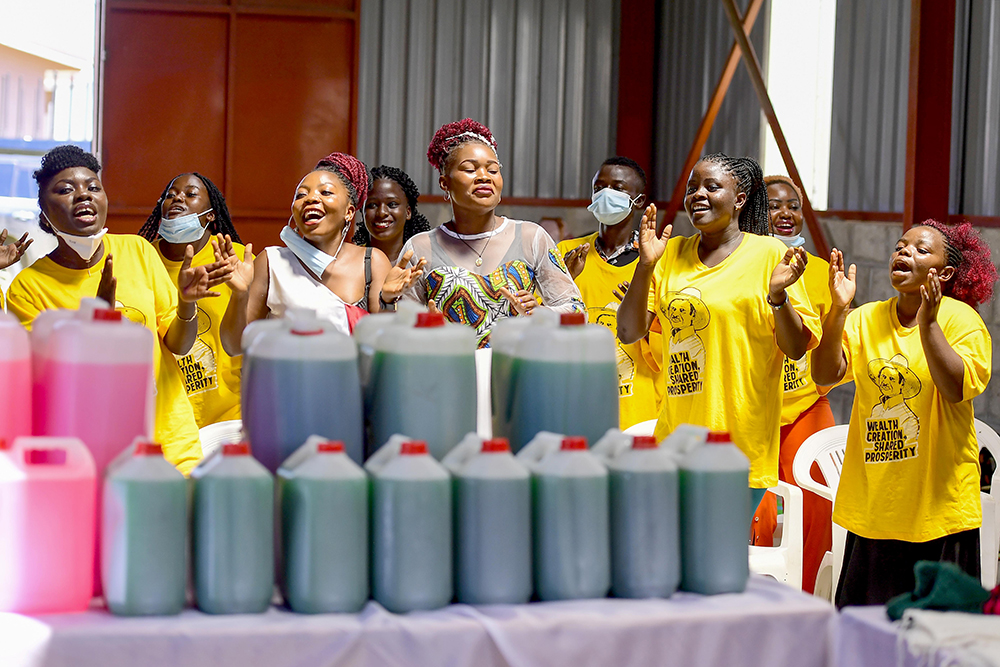
Tayebwa pledged Parliament’s continued support for the initiative, noting that the testimonies from graduates reflect the program’s real impact.
“What we are witnessing today are not mere statistics; these are lives transformed. A girl now owns a salon, a young man is building homes, and another is saving to build rentals. These are powerful stories of hope made possible by this initiative,” he said.
He urged local communities and leaders to protect and sustain the hubs, adding that such investments are vital for national development.
He also encouraged the youth to take full advantage of the free training and facilities provided.
“To the beneficiaries, this is your moment. Use the skills you’ve gained to lift not just yourselves, but your families, your villages, and our country,” he said.
William Kasozi, the zonal chairperson for the Presidential Industrial Skilling Hub, lauded the President for establishing the hub in the region, saying it has sparked a critical shift from subsistence living to income-generating activities among the youth.
“Thank you for bringing this transformative initiative to our region. This hub has enabled job creation and sparked an economic shift into the money economy,” he said.
Kasozi revealed that the current intake has 897 learners, with 378 girls and 519 boys, all drawn from Bundibugyo district, Ntoroko district and Fort Portal city.
He commended the diversity and inclusiveness of the programme, which also supports learners with free accommodation, training and startup capital.
In a move aimed at boosting sustainability, Kasozi announced the creation of the Industrial Skilling Hub SACCO, a savings and credit initiative established by the district hub committee to support graduates and promote entrepreneurship.
He further highlighted key directives issued by the President, including increasing the number of instructors from 240 to 400 to meet growing demand, expanding accommodation to match the rise in student enrolment, introducing new courses such as weaving, plumbing, automobile mechanics, and electrical installation to widen the skill set of trainees.
Kasozi also noted that the rural electrification rate in Ntoroko currently stands at just 8%, making the introduction of electrical training highly beneficial for the region.
“These additional courses will not only enhance job creation but also empower our youth to directly contribute to local development, especially in underserved areas,” he added.
Beneficiaries speak out
Robinah Byamukama said: “I came from Bundibugyo and studied tailoring at the hub for six months. After the course, the LC5 chairperson gave us a practical examination. He said whoever made his shirt best would be rewarded with shillings 100,000.”
Byamukama said she borrowed shillings 30,000 to buy fabric and used a borrowed sewing machine to complete the task. Impressed by her work, the LC5 chairperson supported her with shillings 200,000.
“I added shillings 150,000 and after one month, I had saved 350,000. I went to Fort Portal and bought my own machine. Currently, I supply school uniforms to St Edward Nursery and Primary School, and I have saved over shillings two million. I now own two machines, including one that makes kitenge designs for women. I’m even constructing rental houses using wood,” she said.
“Thank you so much, President Museveni, for this programme. May you live forever.”
Moses Mutegeki from Ntoroko said that he enrolled in the construction course in 2024. After completing the six-month training, he said, he immediately put his skills to work by building houses using bricks.
He narrated that he later applied for a training opportunity with the Uganda Rural Development Training Institute in Kagadi, using the certificate he earned from the hub.
“I was shortlisted, and I am now employed by the NGO to train fellow youth from my home area. The organisation also provides me with a salary and materials for the sessions,” he said.
Together with fellow alumni, Mutegeki formed a construction enterprise. The group successfully applied for shillings eight million under the Youth Livelihood Programme (YLP), using part of it to operate a salon. The remaining shillings four million, is being saved for a new initiative of manufacturing pavers locally to meet community demand.
“If this hub had come ten years ago, I’d be much further in life, but even in this short time, I’ve achieved a lot. My home is comfortable because of the opportunities this program gave me,” he remarked.
Christine Sanyu from Bundibugyo first learned about the skilling opportunity through a local radio station announcement. She applied through the district office, and she was admitted for a course in hairdressing.
Starting with savings as little as shillings 2,000, Christine said that she gradually invested in her dream and today, she owns a salon and employs others, evidence of how even modest beginnings can lead to success when matched with the right skills.
She attributed her progress to the Presidential initiative, saying it gave her the practical knowledge and confidence to run her own business.
The event was also attended by information minister Dr Chris Baryomunsi, State House comptroller Jane Barekye and Members of Parliament, among others.