
Sudan's largest oil field falls to RSF as fighting rages in south
Since pushing the army from its last Darfur holdout in late October, the RSF has shifted its focus to neighbouring Kordofan, where a drone attack on a kindergarten and hospital killed 114 people, including 63 children, last week, according to the World Health Organisation.
A Sudanese woman who fled El-Fasher in Darfur carries jerrycans of water at the Al-Afad camp for displaced people in the town of Al-Dabba, northern Sudan, on November 21, 2025. (AFP)
__________________
PORT SUDAN - Sudan's Rapid Support Forces seized the country's largest oil field on Monday, paramilitary, army and industry sources said, as fighting intensifies in the strategic, resource-rich south.
Since pushing the army from its last Darfur holdout in late October, the RSF has shifted its focus to neighbouring Kordofan, where a drone attack on a kindergarten and hospital killed 114 people, including 63 children, last week, according to the World Health Organisation.
"The liberation of the Heglig oil region is a pivotal point in the liberation of the entire homeland, given the region's economic importance," the RSF said in a statement Monday.
An RSF source told AFP the base housing the local army division had also fallen.
An engineer at the Heglig field, in the far south of Kordofan, confirmed the RSF's takeover of the facility, telling AFP the team had "shut it down and halted production, and the workers were evacuated to South Sudan".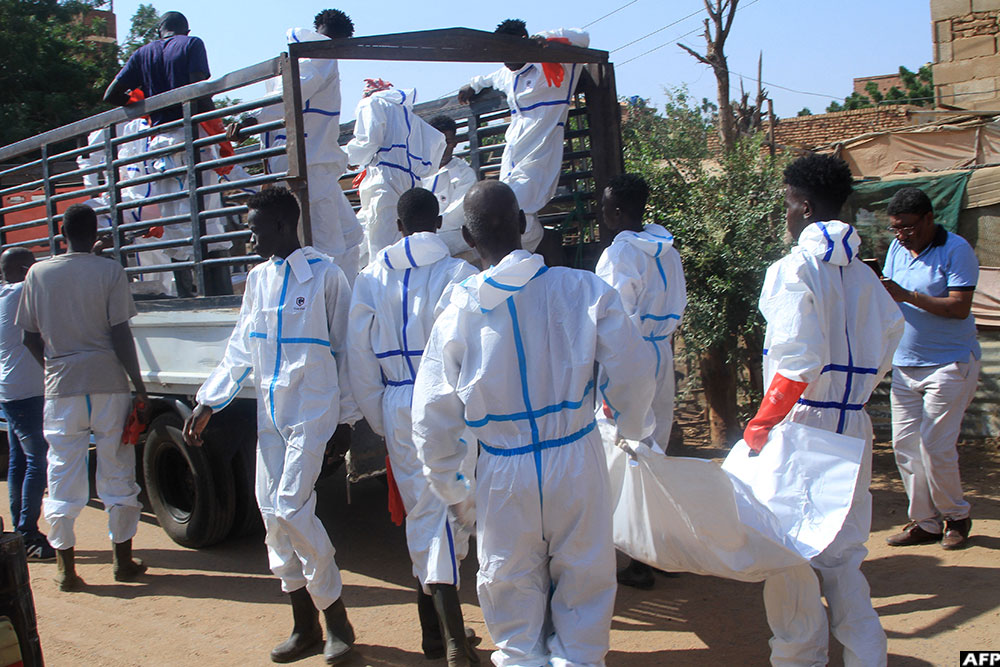
Employees working for the authorities load a body bag into the back of a lorry as bodies are dug up from an emergency burial site inside a school, to be buried in public cemeteries, in Sudan's capital Khartoum on December 8, 2025. (AFP)
Army forces withdrew "to protect the oil facilities and prevent damage", a military source told AFP.
The three sources spoke on condition of anonymity because they were not authorised to speak to the media.
In a statement, an RSF-led alliance pledged to "secure all oil installations" and allow engineers and workers to carry out necessary maintenance "without any obstacles", ensuring production continuity.
Battle for Kordofan
Since April 2023, the army and the RSF have been locked in a brutal conflict that has killed tens of thousands of people, displaced 12 million more and devastated infrastructure.
The RSF's advance in Kordofan is backed by the Sudan People's Liberation Movement-North (SPLM-N) faction, led by Abdelaziz al-Hilu, which controls much of South Kordofan and parts of Blue Nile state.
The two groups allied earlier this year, forming a coalition based in South Darfur capital Nyala, which now governs the western region.
WHO chief Tedros Adhanom Ghebreyesus condemned Thursday's "senseless" strikes on South Kordofan's Kalogi, which local authorities and the army-aligned foreign ministry blamed on the RSF and Hilu's SPLM-N.
In a statement on Monday, the SPLM-N faction said the capture of the long-besieged South Kordofan towns of Kadugli and Dilling is "only a matter of time", urging the army and allied militias to withdraw and open "corridors for citizens to leave to safe areas".
In an interview with AFP, Doctors Without Borders (MSF) president Javid Abdelmoneim called on both sides to "allow humanitarian and medical workers freedom, protection and access to the population".
Oil revenue 'disaster'
The Heglig field, Sudan's largest, is also the main processing facility for South Sudan's oil exports, which make up nearly all of Juba's government revenue.
"The processing plant near the field through which South Sudanese oil passes was also shut down," the engineer said.
The pipeline carrying oil from the southern border to Port Sudan on the Red Sea is a key source of income for impoverished Sudan, whose economy collapsed during the war.
When Juba seceded in 2011, it took nearly all of Sudan's oil deposits. Heglig, long disputed between the two countries, saw brief clashes in 2012.
The RSF also controls major oil fields in the west operated since the 1990s by China before being forced shut early in the war.
Last month, the Chinese National Petroleum Corporation informed Sudan it would end its investments, according to a copy of the letter seen by AFP.
Former oil minister Gadein Ali Obeid called the situation a "disaster", saying Sudan has now lost its two main oil-producing regions, Heglig and Block 6, referring to the Chinese-operated site further west.
"All of Sudan's oil production originates from both of them... Even oil from Block 6 was processed at Heglig, which used to handle between 80,000 and 100,000 barrels per day for Sudan and South Sudan," he added.
Since losing their last toehold in western Darfur, the army has been on the defensive, trying to halt the paramilitary advance through Kordofan and back towards the capital Khartoum.
Sudan is now effectively split in two, with the army holding the north, east and centre, and the RSF in control of the west and, with the help of its allies, swathes of the south.