
Moyo, Obongi voters want leaders to fix Laropi Bridge to ease access
“We know that the President is already committed to the bridge, and it is in the NRM manifesto. However, we are requesting for its fast-tracking because this is going to benefit the entire East African Community and the Great Lakes region.”
The Laropi ferry, which connects Moyo to Adjumani on the Nile, operates according to fi xed timetable which limits the trade and transportation potential. (Credit: Adam Gule)
By Nelson Kiva, Adam Gule and Edward Anyoli
VOTERS’ NEEDS
The voters in Moyo district have asked the Government to fast-track the construction of Laropi Bridge to ensure effective connection with the rest of the country.
The bridge, they say, will also connect Moyo and West Nile to trade the opportunities in South Sudan and DR Congo.
“With the President campaign in the district, our first demand is the construction of Laropi Bridge over River Nile. We have the Laropi ferry, which connects Moyo to Adjumani. However, it operates according to a timetable. While the rest of Uganda is able to move day and night, the people of Moyo can only go to Kampala during day time,” Moyo LC5 chairperson Williams Anyama said.
“We know that the President is already committed to the bridge, and it is in the NRM manifesto. However, we are requesting for its fast-tracking because this is going to benefit the entire East African Community and the Great Lakes region.”
The bridge issue
The bridge, Anyama said, will shorten the distance to South Sudan’s capital, Juba, through Moyo-Okediji.
“This is also going to be a gateway to the Central African Republic. Connected to the bridge is the road leading from Laropi to the border with South Sudan. We regard this a single project,” Anyama said.
According to the Government, the Laropi Bridge — which will be constructed in partnership with the African Development Bank — will be 1,200 metres wide.
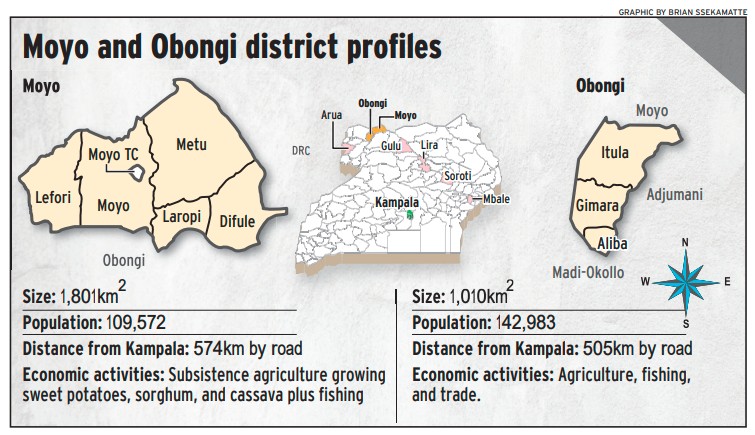
The bridge, according to the works ministry, will be at a spot where the Atiak-Laropi road intersects with that of Laropi-Moyo-Afoji on River Nile. Moyo and Obongi have a population of about 252,000 people, going by the 2024 National Population and Housing Census figures.
Moyo was created in 1980 from the then Madi district, while Obongi was carved out following legislation by Parliament.
The local economy of both districts is hinged on agriculture, with over 80% of the population involved in subsistence farming, including key crops like maize, cassava and simsim.
However, Moyo leaders said they are now promoting crops such as coffee, cocoa and avocado in a bid to commercialise agriculture in the district.
Common challenges
The challenges enlisted by the voters in both districts did not differ much from those affecting the entire sub-region.
They include roads, healthcare, electricity connectivity, water and sanitation, poverty, unemployment, education, agricultural services, land management and a high crime rate.
For instance, the challenges listed in the health sector included walking long distances to health facilities, lack of medicine in health centres, unprofessional conduct among healthcare staff, shortage of personnel, poor medical infrastructure and overcrowding.
These issues are also reflected in the New Vision Citizens’ Manifesto conducted between March and May this year, where they highlighted key bottlenecks undermining service delivery in the spheres of healthcare, roads infrastructure, water and sanitation, poverty, unemployment, power connectivity, education, agricultural services, land management, crimes and leadership, among others.
To ensure a national outlook, the Citizens’ Manifesto and the survey covered 6,006 respondents from 58 districts across the 17 sub-regions.
The respondents were randomly sampled from both rural and urban setups. With NRM presidential flag-bearer Museveni set to campaign in Moyo and Obongi tomorrow, voters in Moyo want Moyo town council to be upgraded to municipality status. The town was formed in 1956, six years before independence.
“Moyo town was created as a town council in 1956 even before Uganda’s independence. But all the other towns of Arua, Gulu, Lira, Soroti, Mbarara, Jinja and Mbale are now cities while Moyo has remained a town council. So, we are requesting the President for special affirmative consideration to elevate Moyo to municipality status,” Anyama said.
Experts’ views
The former Uganda Medical Association president and renowned public health specialist, Dr Samuel Oledo, said West Nile is blessed by being located at the border of two countries (DR Congo and South Sudan), gifting it an opportunity to access these markets.
“Now, the concept of the President on economic transformation comes into play, especially value-addition so that we do not export raw materials, but we end up exporting finished goods or semi-finished goods and services,” Oledo said.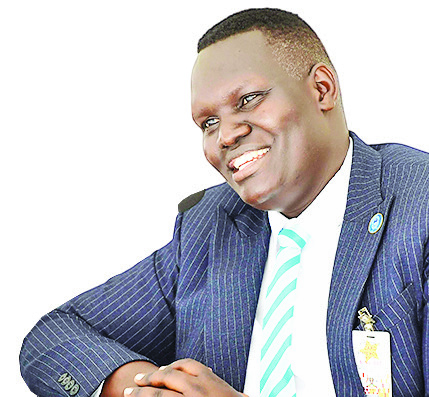
Dr Samuel Oledo
On his part, David Atuhura, an educationist, said the transformation of West Nile will be achieved when the Government makes it mandatory for all children in the sub-region to study.
“When I move around that area, I see so many children not in school. The number of school drop-outs in that sub-region is also alarming. So, there is a need for the Government to promote family planning so that homes can manage the children,” he said.
Cattle raids: Appeal for compensation
Moyo is also asking the Government to compensate the victims of the South Sudan cattle raids on the border.
“We are bordering South Sudan. On two different occasions, we experienced violent cattle raids by the South Sudanese armed forces. We lost our animals and farmers lost their cattle to the South Sudanese armed forces,” the Moyo LC5 chairperson said.
Poverty indicators rank Moyo among the poorest districts in the country, which calls for affirmative intervention, according to the authorities.
The voters are, however, appreciative of the Government for connecting Moyo district to the national electricity grid. The residents, however, requested the next government to consider rural electrification.
Authorities say the power has not yet reached most schools, health centres and police posts, especially those away from the main road.
The Moyo district budget is about sh30b, and it is striving for a community that is economically productive and prosperous. Obongi is lacking electricity connectivity, despite that fact that authorities in both districts outlined the ambitious transformative programmes in areas of health, education and agriculture.
“In the whole country, I think it is only us without electricity. I have been advocating for it on every platform I get, but without success. The situation has affected modern systems in the district. We normally use solar, and when it rains heavily, we are stuck,” Haji Habibu Khemis Buga, the LC5 chairperson of Obongi, said.
Electricity: Government efforts
On August 3, last year, President Yoweri Museveni commissioned the 289km Kole?Gulu-Nebbi-Arua 132kV transmission line and the associated 80 megavolt-amperes 132/33kV sub-stations at Kole, Gulu, Nebbi and Arua — eventually connecting West Nile to the national electricity grid after many years of dirge.
This came after government initiatives such as Nyagak III hydropower plant, Nyagak 1 and Karuma hydropower dam.
“Power outages in West Nile should be history. The focus now is attracting investors for industrial parks to utilise the region’s 90MW capacity, far exceeding the 10MW local demand, to drive job creation and development,” Ruth Nankabirwa, the energy minister, said recently while presiding over the commissioning of Nyagak III.
Obongi demands
Voters in Obongi said their district not being connected to the electricity grid is a key missing link that has frustrated both businesses and investment. As a result, voters want leaders to address this matter.
They have also called on leaders to rehabilitate the 80km road from Obongi to Moyo, and to upgrade Obongi Health Centre IV to hospital status.
The other issue that voters want is the upgrade of Itula Health Centre III to health centre IV. Obongi has a total of over 500km, with those under the district totalling about 172km.
Buga said the district has registered key progress in the government programmes including the Parish Development Model, claiming that the district ranks well in terms of performance.
“We have 28 parishes and all of them have benefited from the programme. The Emyooga has also done well,” Buga said.
“In the health sector, we have constructed an outpatient department and the general ward at Iboa Health Centre II and Pelemelim Health Centre II,” Buga said.
Obongi’s total district budget is about sh16b (2025/2025), and it was reduced from sh17b in the last financial year 2024/2025 due to the budget cuts. Buga said the district is able to contribute only sh600m in local revenue, while over 90% 0f the district budget is contributed by the central government.
The development priorities for both Obongi and Moyo — that voters pointed out — range from improving health services, education, agriculture and roads. Monday Eyotaru, a youth leader in West Nile, said the President needs to address the issue of the vocational training programmes and the support for education initiatives that equip young people with employable skills.
“In addition, I would like the President to address unemployment and job creation, as well as ways of supporting small businesses in the sub-region,” the youth leader said.
What people say
Grace Mazira , resident of Metu sub-county in Moyo: I want the Government to quicken the process of constructing the Laropi Bridge along with Laropi-Afoji road that links Uganda to South Sudan.
Christopher Tiondi, resident of Moyo: The border conflicts between Uganda and South Sudan, that have persisted for decades, have claimed many lives over the past years and hinder the smooth running of economic activities across the border of the two countries.
Dominic Ojaa Idro, resident of Moyo town council: The Government should intervene in the construction of Celecelea Stadium, in Moyo town council that has long been ignored by the local government, hence leaving the locals to struggle when it comes to sports.
Dominika Tarakpwe, resident of Dufile sub?county in Moyo district: The issue of the elephants disturbing people of Dufile should be resolved once, and those who lost their property and lives should be compensated by the Government.
Innocent Adroni, student leader in Obongi: The Government should address the education challenges in Obongi. We have very few government teachers, and our school isn’t connected to the national electricity grid. Sometimes, we read using lanterns because there’s no power. How can students perform well under such conditions?