
Lira, Kole voters table solution on cattle compensation
Despite developments, Odur and other voters in Lira and Kole said there are key pressing issues that leaders must fix, including limited access to heath services, high cost of education coupled with high dropout rates, bad roads, agriculture and food security concerns, high level of crime, poverty, poor supply of electricity, corruption, unemployment and land grabbing
Lira, Kole voters table solution on cattle compensation
CITIZEN'S MANIFESTO
Lira city serves as the main urban centre of the Lango sub-region. It is also the epicentre for business and the dicey political fulcrum of the region.
Following the recovery of northern Uganda from the Lord’s Resistance Army insurgency, Lira town has enjoyed relative peace with new economic activities that have turned it into an industrial and commercial centre of the sub-region.
As a result, tribes from the neighbouring districts have settled in Lira, making it a primary business hub in northern Uganda.
The economy is characterised by a diverse mix of industrial, commercial, and agricultural activities.
The city’s economy is predominantly based on commerce, serving as a central market and distribution point for agricultural products from the surrounding rural areas.
Major economic activities include trade in agricultural products such as grains, legumes and other produce, retail and wholesale commerce, service industry and other sectors.
The city hosts several markets, including the main market (Lira Central Market), which is one of the largest in northern Uganda, attracting traders and customers from across the region.
So, to tap into this emerging vibrant economy, the Government has constructed the 12km pipeline to transfer water from Angwetangwet to Lira University, drilled hundreds of new boreholes with mini treatment systems at Ngetta and Lango College, constructed the Kaguta bridge connecting Lira to Otuke, Pader, and Abim districts.
For the education sector, construction works for new seed secondary schools was recently unveiled, while plans to upgrade Barlonyo Agro-Technical Institute to an agricultural college were also rolled out early this year.
Lira Central Market, which is pivotal for agricultural trade, was also refurbished, while strategic funds have been provided by the Government to boost fishing, tree farming, horticulture and poultry to supplement the Parish Development Model efforts to reduce poverty and create jobs.
This is in addition to community skilling to improve community members’ skills and provide mentorship to foster job creation and positive mindsets.
“Financial literacy and savings initiatives have been put in place to build a savings and borrowing base through co-operatives, promoting financial literacy for growth,” Sammuel Otwol, a financial consultant in Lira city, said.
As a refugee-hosting district, Otwol said, Lira is known for hosting refugees from South Sudan and Somalia, contributing to the city’s diverse population and economic activities.
In the neighbouring Kole district, which was carved out of Apac district in 2010, a number of development projects have also been completed.
Musa Odur, the Kole district senior assistant chief administrative officer, said the projects include the sh4b Kaguta Complex that houses the administration and other government offices, Ayara and Lwala health centres III constructed in Okwerodot sub-county that have greatly improved the delivery of health services in the area and the construction of Okwerodot and Okole seed schools in the district under the Uganda Intergovernmental Fiscal Transfers Programme.
The sh1b road fund, used for maintenance of district roads, Odur added, has also been utilised to grade murrum feeder roads within the district to enable farmers transport their produce to Lira market.
“Through these projects, Kole district has continued to grow its infrastructure projects and other government projects using government funding. We hope to develop further once the funds are available,” Odur said.
Yet despite the developments, Odur and other voters in Lira and Kole said there are key pressing issues that leaders must fix.
These issues, voters said, include limited access to heath services, high cost of education coupled with high dropout rates, bad roads, agriculture and food security concerns, high level of crime, poverty, poor supply of electricity, corruption, unemployment and land grabbing.
Cattle compensation is the other major issue that voters in Lira and Kole singled out, noting that it cuts across Lango sub-region.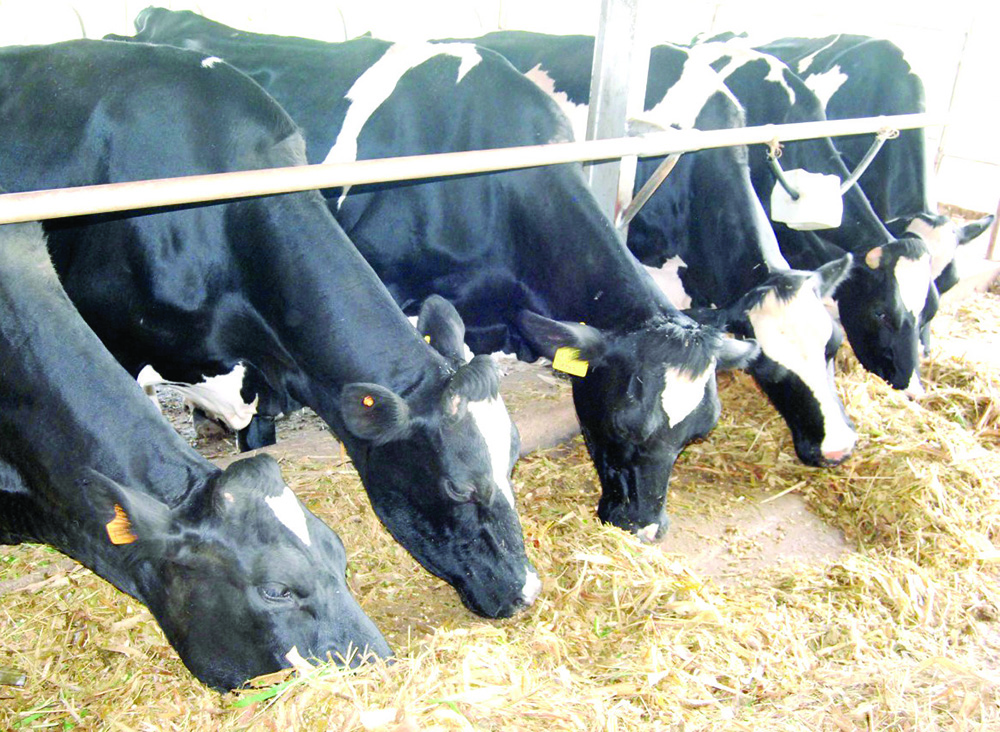
Cattle compensation is the other major issue that voters in Lira and Kole singled out, noting that it cuts across Lango sub-region.
People’s manifesto
These issues are alive to the findings of the Vision Group survey, which was conducted in March and May this year.
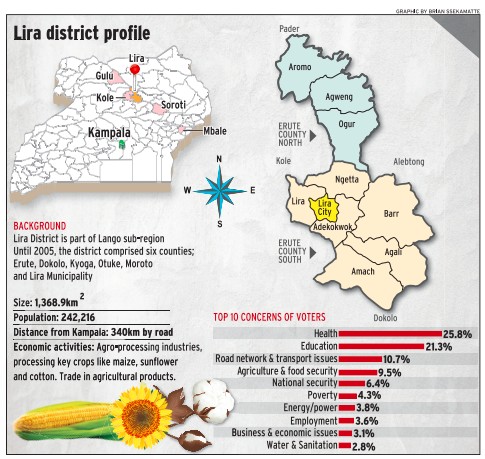
According to the survey, 25.8% of the sampled voters in Lira singled out health-related issues as key pressing challenges, noting that they walk long distances to access medical care.
Shortage of drugs, limited health centres in the district and shortage of healthcare personnel are the other issues sampled voters raised. 25.2% of the sampled respondents in Kole district raised similar health-related challenges.
“Lira district is not doing well on issues of healthcare services. As woman MP, I have had to use my own money to buy fuel for the generators. We have electricity, but it is dim. We have on several occasions talked to the energy ministry over the matter, but we have not yet got answers,” Agnes Linda Auma, the Lira District Woman MP, said, adding that in some health centres, medical personnel use mobile phone lighting to attend to patients at night.
The solution to this problem, Auma said, is to upgrade and fully equip the health centres with solar-powered alternative energy sources.
Monitoring government services, especially delivery of drugs, is the other solution Auma offered, adding that the Government proposal of constructing a health centre at every sub-county should also be implemented.
William Onyanga, a local leader in Lira, proposed that by decisively dealing with corruption, drug stockouts in Lira district health centres will be stamped out.
Neslon Okor, another voter in Lira, argued that by investing in the healthcare system, agriculture and education, the Government would have automatically rooted out poverty because these sectors are key drivers of the economy and social-economic transformation.
“We also need to have Aboke Health Centre III upgraded to a hospital. Hundreds of our people suffer here due to lack of healthcare and are only referred to bigger hospitals,” Okor said.
Roads
The other pressing issue that voters in Lira and Kole cited is the bad state of community feeder roads.
According to the survey, the majority of the voters in Lira and Kole said most of the community roads were in bad state, noting that during the rainy seasons, most areas are cut off from Lira city.
Emmanuel Okot, a farmer in Lira, said the bad roads were hampering the transportation of agricultural produce to markets.
“In Lira, the majority of the people are farmers. Our main agricultural produce are oil seeds and maize. Unfortunately, we are not producing as much as we should because we don’t have where to sell them. The roads are so bad that you will need more money to transport a few items to the city. We don’t have that money. We appeal to the Government to help us work on these community roads,” Okot said.
Erute South MP Jonathan Odur, however, said the Government allocates sh1b to districts and local authorities every year for maintenance of murrum feeder roads, noting that this money should be deployed to fix the community roads.
The only roadblock, Odur added, is the state of road maintenance equipment that districts use to maintain these community roads.
“Just like roads, the road maintenance equipment also needs to be maintained because they keep on breaking down, and in most cases, there is no fuel to enable them move,” Odur said.
On his part, Sam Atul, the Lira city mayor, said the Government should revamp the railway line out of Lira town and also actualise the industrial park.
“We provided the land for the industrial park, but work is yet to kick off. Our hope when it comes to provision of jobs to the youth lies in this park,” he said.
“Key strategies should involve a bottom-up planning approach, identifying new revenue streams, investing in infrastructure like roads and social services, and improving planning capacity and timely fund release to achieve district objectives,” Atul added.
According to the survey, lack of well-paying jobs, low prices for agricultural products, limited capital for farmers, limited access to safe and clean water, poor housing, insecurity within the community, increased theft and robbery cases, frequent electricity outages and high cost of electricity installation are some of the other issues that sampled voters raised.
Kole district, which borders Lira, has bore the burden of poor service provision in its mother district.
Andrew Awany, the Kole LC5 chairperson, said the district, which neighbours Lira, needs urgent attention if they are to root out unemployment and lack of health services.
“Many people come from surrounding areas such as Lira and give us an extra burden when it comes to service provision. Kole also needs to be connected to the national power grid,” Awany said, adding that development cannot be realised without access to electricity.
Henry Omoo, Lira’s senior planner, said the magic solution to Kole and Lira challenges lies in strategic planning that starts from village level.
“With this planning, people’s proposals and priorities would then be integrated in the parish plan. But there is a need for political will if we are to do this,” Omoo said.

Few teachers in government secondary schools within the two districts is the other pressing issue voters singled out. (New Vision/Files)
Education
According to the Vision Group survey, education-related challenges were also prominently cited by sampled voters within Lira and Kole, with 21.3% and 13.6% of the sampled respondents, respectively, saying the continued demand for school fees by some headteachers, despite the existence of universal education in primary and secondary government schools, has kept many children out of school.
Few teachers in government secondary schools within the two districts is the other pressing issue voters singled out.
Recently, in his address to taxi operators, President Yoweri Museveni, who is also the presidential candidate for the ruling National Resistance Movement (NRM), said Government will recruit 50,000 more teachers in public schools to support the free education programme.
Museveni said the implementors of the free education programme were frustrating its progress, noting that in some government schools, private teachers were hired by headteachers, something that explains the issue of fees in universal schools.
“The headteachers have been giving excuse of not having enough teachers. They end up hiring some teachers. But we have done our calculation, and it shows that we need 50,000 extra teachers. We are going to recruit them and remove that excuse of lack of teachers. Our children must study for free and empower their livelihood,” Museveni said.
Currently, the Government has 180,000 teachers in public schools teaching nine million learners under Universal Primary Education and 900,000 in government secondary schools. Of the total teachers in government schools, 130,000 are in primary schools.
Compensation
The other key issue that voters raised is cattle compensation. Voters said this matter has been on table since 2022, adding that it must be resolved. Recently, the Government said sh473b is required to compensate about 130,00o victims, whose livestock and property were destroyed during the LRA insurgency.
“As we approach the 2026 elections, it is crucial we address this issue. The regions seeking compensation are among the poorest. This compensation could help reduce poverty and foster national unity,” justice minister Norbert Mao told Parliament in August.
To resolve the never-ending question of cattle compensation in northern Uganda, on Monday, Museveni and a committee of 20 eminent persons agreed that a new equitable method be adopted.
Rather than basing on the old formula of compensating only those who went to court numbering about 130,000 victims, the President and the team of individuals from Lango sub-region, headed by the health minister, Dr Ruth Aceng, reportedly agreed that the compensation be based on household.
According to the source, the committee proposed that instead of money, each household in the affected region gets five animals (two bulls and three cows).
“We all agreed that the current formula is expensive and has been infested with corruption and cannot work. “We said, let us get a new method of compensation since the majority of the people of northern Uganda were affected.
The President agreed with our idea, but said he will meet with the ministers of finance and agriculture and the Uganda People’s Defence Forces and see how to implement this win-win way forward,” a top leader in Lango sub-region told New Vision.
What leaders, voters said
Tonny Obua, driver Lira City
We want the Government to sort out the unfair distribution of cattle compensation. Some individuals have received compensation multiple times, while some of us have never benefited.
Sam Atul, mayor Lira city
In addition to other social services that are missing, the road network within the city has deteriorated and needs to be worked on. Lira city is the lifeline for many people in neighbouring areas.
Jonathan Odur, Erute South MP
I want them to address the problem of security for the people and their properties. Today, people have stopped moving at night. There is no economic activity that takes place at night unlike in the past, the cost of hiring a security guard is high, people have sleepless nights.
Grace Akobo, vendor
The sh1m we get under the Parish Developmental Model is not enough. It is a good initiative, but sh1m is not enough to lift beneficiaries out of poverty. So, Government should increase the funding per person.
Moses Odongo, Lango Paramount Chief
The heads of families who lost cattle have, in many cases, passed away, leaving children and grandchildren still waiting. Let us take decisive action so that this matter is sorted.
Charles Ocen, farmer
There is a visible inequality in public service delivery that must be addressed. Favouritism in job allocation within the districts of Kole and Lira could damage the image of public institutions and negatively influence future generations.
Samuel Opio Acuti, Kole North MP
This matter of cattle compensation touches the bone marrow of issues affecting Lango. We must settle it with certainty and finality.
Jimmy Akena, Lira City East MP
The biggest issue right now in Lira is why their son, Jimmy Akena is not on the presidential ballot paper. The people of Lira want the President to respond to that issue because he is the head of government and he must be knowing why.