
How Luwero pineapple farmers are reaping from tourism
Mwanje, a local farmer says, apart from having all his pineapples booked for export all-year round, the 'pineapple hunt' is such an activity that has attracted many foreign tourists to the Luwero landscapes.
A group of tourists displaying their catch after a successful pineapple hunt at Sulma farm in Luwero district. (Credit: Julius Luwemba)
LUWER0 - Leaving Kampala for a countryside tour, is described by many, as an escape from the bustle and hustle of the compacted city.
It is a seamless transition of losing sight of the flamboyant display of malls and heavy traffic to a view of greener landscapes and inhaling organic fresh air.
The Saturday agro-tourism trip to Luwero saw a group composed of mainly tour operators visit the once war-torn area of Luwero, which has since transitioned into a bustling busy town.
As budding writer Ann Agwanga put it: On such trips, the reality of personality types becomes more pronounced as some people prefer to read a book while others keep gazing outside the car window.
"Still, others will die for chitchat about nothing and everything before they become the best of friends, hours into the journey," she says.
The Luwero countryside was a view of scattered settlements, interspersed with verdant embrace of forest reserves among other sprawling vegetation.
After a couple of hours into the journey, the team arrived at Sulma Farm, a resource centre for agro-tourism located at Bulema-Lwogi, situated about 10km from Kasana-Kikyusa road in Luwero district.
Nothing warms the heart like top-notch hospitality. Beaming with a wide, infectious smile, Zahra Muhamed ushered the visiting team to the waiting chairs arranged below a soothing embrace of the tree-shed.
Clad in such attire that leaves no doubt, she is a typical Muslim. Zahra, together with her children and some in-laws, have kept steering the family agri-business since she lost her husband years ago.
Satiated with the cold welcoming juice, we were ready for the briefing and introductions. Wasting no time, Farid Karama, another family member offered an overview and the history of Sulma farm which cultivates, processes and exports fruits mainly to Japan and the Middle East.
Pineapple hunt
The 20-acre farm also supports a network of over 800 small holder farmers, focusing on sustainable practices and value-addition. Each tour operator was given a pair of gumboots before being led to one Paul Mwanje's two-acre pineapple farm.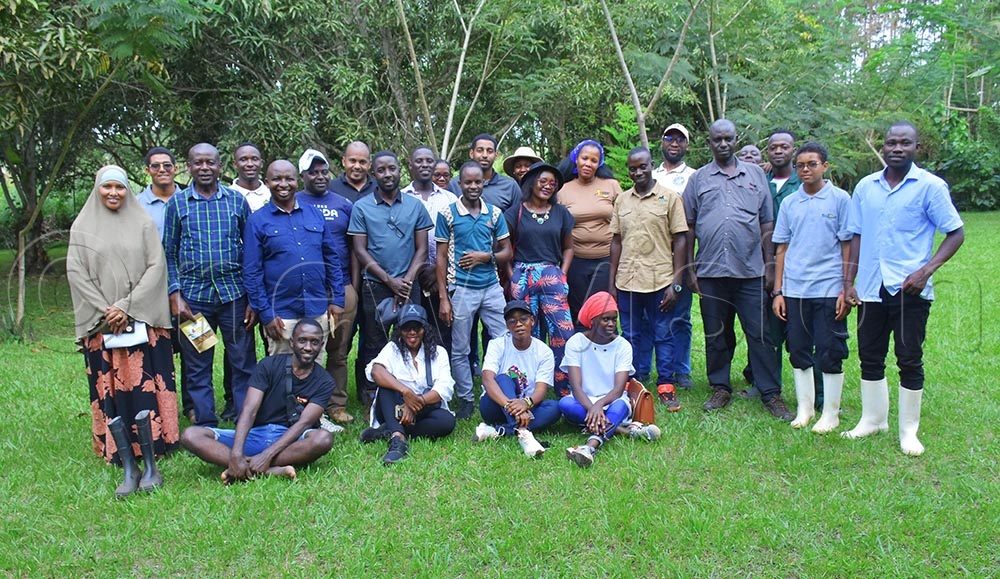
A group of select tour operators during their visit to Sulma farms in Luwero district. (Credit: Julius Luwemba)
Here, the tour operators joined a team of Japanese for a pineapple hunting spree. Regarded as a game, tourists are allowed to venture into an expansive garden full of pineapples, to look for only the ripe ones.
"It is an activity which many tour operators have adopted into their itineraries where a small fee is charged from each tourist who takes part in the pineapple hunt," Farid said, adding that each participant is granted a chance to search and pick a ripe pineapple, which they take free of charge.
"But they are free to take extra pineapples, provided they (pineapples) are paid for," he added.
Mwanje, a local farmer says, apart from having all his pineapples booked for export all-year round, the 'pineapple hunt' is such an activity that has attracted many foreign tourists to the Luwero landscapes.
"It is like a fishing expedition which many tourists love to participate in," Mwanje stated.
Samuel Mugisha, a tour operator under Bic tours saidthe pineapple hunting package has diversified the tourism products offered in Uganda as well as improving the income of Luwero farmers.
"In case the tourists are in a group of five or more, each one is charged $35 (sh120,000), and for a group having less than five tourists, each one is charged $4 (sh140,000)," Mugisha intimated.
Peter Odite, another resident of Luwero, said pineapple hunting continues to attract tourists heading out to wildlife parks such as Ziwa rhino sanctuary, Murchison Falls national park, Kidepo National park, among others.
"It is such a tourism activity carried out on most of our local farms. But to ensure good standards and a proper customer care service, we agreed that all the bookings and reservations are done through Sulma farm before it trickles down to individual farmers," Odite said.
Punctuated with Matooke (plantain) plants, the gleaming pineapple gardens thrive in the dappled shade of surrounding towering trees. Undergrowth within the plantations is controlled by mulching, using the same leaves and husks peeled off the harvested pineapples.
The fresh look of every plant on and within the farmland is a testament to organic agriculture, where chemical fertilisers are taboo. Even rodents and snakes are barred by some plant species grown around each garden.
The pineapple hunt was more of a fun, engaging activity, flanked with laughter and storytelling, than merely looking for a fruit.
Walking through the pineapple gardens opens to each tourist the reality of farming with an embrace and a testament to the idea that the earth yields more when asked than when forced. Venturing farther into the gardens, every bodily sensory nerve is served. The hunt is more than a pineapple search; it's a soul-fulfilment.
After the tour of adjacent farms and observing the entire food processing and value-chain at Sulma farms, it was time for a quick bite of the organic munchables before the shadows became taller- a signal of the day's dusk.
The story at Sulma farm is more than agriculture, processing and export. It is a story of tourism, sustainability and diversification.