
How safe are nutritional supplements you are consuming?
New Vision Online investigation revealed that some uncertified energy drink products, including those with expired licenses, are being sold in some shops and supermarkets in Soroti city and various districts in the Teso sub-region.
Acting manager of Alakara in Soroti city, Benard Eningo, speaking in his offices. (Credit by Delux Emmy Alomu)
________________
Amuria district resident Stephen Ojwiny, whose real name has been withheld, experienced a serious health setback after consuming a brand of nutritional supplement in 2025.
Ojwiny, at the time, did not verify whether the drink was certified by the Uganda National Bureau of Standards (UNBS) or check its expiry date. Unfortunately, this oversight led to him losing his ‘manpower,’ highlighting the risks of using uncertified or expired health products.
“Initially, I felt a boost in strength, but after continued consumption of the beverage, whose name I do not remember, that energy faded, prompting me to stop drinking it altogether,” he said.
Soroti district Gweri sub-county-based resident Daniel Ekuriei says many are easily swayed to purchase these supplements due to unsubstantiated claims about their health benefits, including the promise of enhanced manpower and prevention of chronic diseases.
However, he soon learned that some of these products are not as pure as they claim to be; they may contain harmful chemicals. While some of these supplements may provide a temporary boost, Ekuriei warns that the long-term consequences can be quite dire.
After witnessing a friend suffer serious health complications linked to these supplements, Ekuriei chose to discontinue their use. Similarly, Lawrence Chuma from Moru Village in Katakwi district, believes some Kombucha drinks pose health risks since numerous manufacturers are more interested in profit than public wellness.
Ojwiny and Ekuriei's experiences are not isolated; many others consuming these supplements are silently suffering. They often fall for the belief that “natural” products are automatically safe. This widespread misconception highlights the urgent need for regulation in this sector, as the lack of oversight poses significant threats to public health.
The market for "natural" nutritional supplements in Uganda is growing rapidly but is still largely unregulated, resulting in an increase in counterfeit and contaminated products.
During New Vision Online's investigation, many consumers of this particular local energy drink in Soroti hesitated to share their experiences, fearing that people would misconstrue their use of these beverages as a sign of low manpower.
Isaac Orone, a bodaboda rider based in Soroti city, says he has turned to local waragi and has abandoned thoughts of nutritional supplements altogether.
New Vision Online investigation revealed that some uncertified energy drink products, including those with expired licenses, are being sold in some shops and supermarkets in Soroti city and various districts in the Teso sub-region.
A quick check on the UNBS website shows that nationally, about 192 energy drink brands have expired permits, while only around 168 hold valid ones.
Peter Michael Opio, owner of GoalMan supermarket Soroti City. (Credit by Delux Emmy Alomu)
Cocktail of mulondo and ginger
A product produced in Nakatunya ward, Soroti city, West, is one such product that had its permit expire on September 13, 2024, according to the UNBS website. Despite this, it continues to be available in the market.
On March 17, 2026, I visited the production site for the local beverage around midday. Initially, the reception was less than welcoming. When I met one of the supervisors, also acting manager, Benard.
Inside the facility, constructed solely from iron sheets, I learned about the production process of the beverage. However, I was not permitted to take photographs or capture videos for unspecified reasons. I noted that the entire operation was done manually, involving 20 workers and 10 people in management roles.
As he described, the production process begins with boiling water, to which ginger, tea leaves, and a bit of Mulondo are added. The mixture is then cooled in large open plastic drums, where additional ingredients make their way in before being transferred to the refilling tank. From there, the product moves through the production chain, where it is bottled, labelled, sealed, and packed for sale.
He claimed that many people choose their beverage because the ginger and Mulondo in their drinks increase manpower, alleviate stress and fatigue, lower blood pressure, and help treat flu and cough symptoms. Bernard mentioned that their product is distributed throughout Teso, including the West Nile region.
Eningo also pointed out that officials from the UNBS visit their production facility every year for inspections. He asserted that their beverage is certified and that they renew their certification annually; without it, he claimed, they would be sealed off.
The acting manager raised concerns about the burdensome taxes that high manufacturers face, especially considering their role in reducing unemployment within the community.
When questioned about the sale of uncertified or expired products, Peter Michael Opio, owner of Goal Man Supermarket in Soroti city, said it is not solely the seller's responsibility to differentiate between authentic and counterfeit beverages.
He added that UNBS should educate both sellers and consumers about the features to look out for when purchasing these products.
His primary concern lies in the potential risks to consumer health, particularly for those mixing various supplements before consumption. Some may be legitimate, while others could be counterfeit, created purely for profit.
True energy sources
Dr John Wilson Etolu, a consultant physician at Soroti Regional Referral Hospital, says there is availability of numerous alternative therapies in the country. However, he advises that individuals consult healthcare providers before taking any supplements to ensure they are safe and certified.
Etolu acknowledges that several individuals have experienced medical complications from consuming nutritional supplements. He cautions against using these drinks as replacements for proper healthcare, and that true energy comes from the food we eat rather than these supplements.
The UNBS has classified most locally produced Kombucha drinks as alcoholic beverages due to the fermentation process. They caution manufacturers about the risks of high alcohol levels, misleading labelling and inaccurate health claims.
Unhygienic conditions under the cover of darkness
Recently, inspectors uncovered that a significant number of beverage products were made under unhygienic conditions.
From November 2021 to January 2022, the UNBS conducted inspections at 65 beverage factories, resulting in the closure of 12 for producing non-compliant and potentially harmful drinks. They also seized shillings 24 million worth of counterfeit or contaminated supplements.
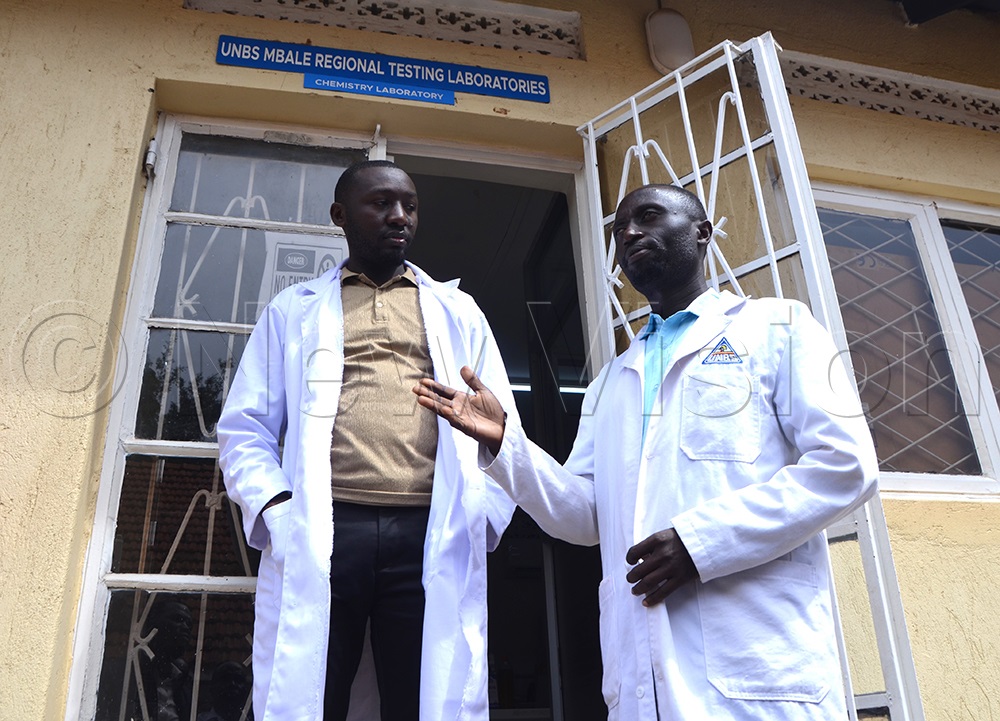
Pius Woniala, a microbiology analyst at the UNBS regional office in Mbale (right) with his fellow worker. (Credit by Delux Emmy Alomu)
According to Pius Woniala, a microbiology analyst at the UNBS regional office in Mbale, some beverage producers have adhered to regulations by obtaining certification, while others remain non-compliant.
He warns that consuming unverified beverages can be unsafe, as some products are illicitly mixed with substances meant to enhance male performance or increase vigour, potentially causing heart damage, while others may contain poisonous ingredients that harm the liver.
When asked why such products are still on the market, Woniala revealed that some manufacturers operate under the cover of darkness, selling their products through backdoor channels that evade UNBS surveillance. He strongly advises consumers to check for a verified UNBS Q-mark on any Kombucha they purchase, emphasising the dangers of unmarked products.
Woniala stated that UNBS market surveillance teams are continuously working to track down these non-compliant products for confiscation and destruction. He encourages vigilance among consumers and the general public.
Additionally, he suggested that Kombucha producers should invest under shillings one million into obtaining certification, which provides a one-year valid permit before renewal. UNBS officials noted that the certification process typically takes about four to six months to complete.
Alfred Edakasi Elalu, the Kaberamaido County Member of Parliament, who doubles as a member of the House committee of trade and industry, says they have tried addressing these issues severally. He says the public should be warned that if they are taking the product without the UNBS logo, they are risking their health.
“I know that a couple of traders are sneaking products into supermarkets and shops, but the public should stay warned until a product has gone through a process of certification; we shall not guarantee its quality,” the MPs said.
Edakasi asked the public to report those fake products to the commercial officer in their district, who is representing the trade ministry where UNBS lies.
According to him, the biggest challenge is that UNBS are so thin on the ground and don't have offices to the last mile, and yet production and consumption are taking place in the last mile.
Investment by the Government
According to him, the Government has to invest a lot more by putting more money into the decentralisation of services so that cities like Soroti have an office so that producers or manufacturers can benefit through certification because some of their products are okay worst of all the process of getting the Q-mark is still long and yet starters don’t have all resources to certify their products.

UNBS Senior PRO, Victoria Namutebi Wamala speaking to the press on Tuesday. (Credit by Delux Emmy Alomu)
Victoria Namutebi Wamala, a senior public relations officer at UNBS, has pointed out that the constraints of a limited workforce and budget have partly contributed to the troubling issue of counterfeit goods being smuggled into the country, a situation she strongly denounced.
Wamala, however, announced that UNBS is in the process of developing a digital tracking system aimed at improving the monitoring of uncertified products through advanced scanning technology.
On the sensitive topic of corruption, she reiterated that one of their core values is a zero-tolerance approach, although she acknowledged that it can still occur. Wamala encourages individuals to report any corruption involving their staff to UNBS for appropriate action.
She highlighted that through their ongoing collaboration with various media partners nationwide, including support from Trademark Africa and Ultimate Media among others, there will be efforts to disseminate crucial information about quality and standards in a language that is easy for the public to understand.
Proxeda Ndagire, representing TradeMark Africa, announced their partnership with UNBS to accredit regional laboratories in Mbale, Mbarara, and Gulu, aiming to lower costs and waiting times for clients who need UNBS services in Kampala.
In the first quarter of 2025, regulatory authorities performed routine inspections on nutritional supplements, among other products in Greater Kampala, unveiling additional compliance challenges associated with these supplements.
Notably, four products branded as immunity boosters were found to make unverified therapeutic claims, with some suggesting they could treat or prevent chronic illnesses. Alarmingly, only one locally manufactured herbal supplement tested showed microbial contamination that exceeded safe levels.
Regulatory authorities have emphasised the need for enhanced market surveillance, greater public awareness, and improved collaboration with manufacturers to ensure adherence to established quality and safety standards.
They reaffirmed their commitment to maintaining accurate measurements, transparent labelling and product safety through regular inspections and laboratory verification.
According to reports from UNBS, about 58% of goods available in the market, including processed supplements, are deemed sub-standard, with 5,707 metric tonnes confiscated in the year ending June 2023. A significant number of locally manufactured supplements, often promoted as herbal, operate without proper regulatory oversight.
UNBS is a government agency tasked with the development, promotion, and enforcement of national standards to safeguard both public health and safety, the environment against harmful and sub-standard products, while also fostering fair trade and competition.
Based on available information, the Uganda Ministry of Trade, Industry and Cooperatives (MTIC), in conjunction with the UNBS, manages the quality of nutritional supplements through standards and enforcement, aiming to ensure they are safe and properly labelled.