
Trust on the shelf: Inside Seeta market’s quiet gamble with standards
“A substandard product fails to meet required specifications and may be unsafe,” Arorwa noted, adding that certification is mandatory for products covered by compulsory standards in health, safety and environmental protection.
Some of the honey being sold in Seeta Central Market, Mukono district. This was on March 3, 2025. The sold honey has no Q-mark issued by UNBS to help consumers identify certified products. (Credit: Lawrence Mulondo)
MUKONO - At 4pm in Seeta Central Market, the air is thick with competing voices. Traders shout out prices as customers squeeze through narrow aisles lined with vegetables, cooking oil and household essentials.
On one wooden stall, tins of honey sit beside fresh greens. None bears the quality mark of the Uganda National Bureau of Standards (UNBS).
Muna, a trader at the bustling market, moves swiftly between customers. One asks for ghee, another for vegetables, but most are drawn to the honey stacked neatly in unbranded tins of varying sizes.
The golden liquid glistens under the fading afternoon light, its origin known only to the supplier.
When asked about the quality of the honey she sells, Muna’s response is disarmingly honest.
“I cannot tell the quality of the products I sell as a vendor,” she says. “I trust my supplier and wait for feedback from customers. If they tell me the honey isn’t good, I go back and complain.”
To her, branding is little more than decoration. Whether the tins carry labels or not does not concern her. She is also unaware of the Q-mark issued by UNBS to help consumers identify certified products.
A few stalls away, another honey vendor, who prefers anonymity, shares a similar story. She buys honey in jerrycans from a farmer and repackages it into tins for sale. Like Muna’s, her products carry no branding or certification marks. She admits she does not know of any standards governing honey production.
Daniel Arorwa, the Surveillance Manager at UNBS, urged entrepreneurs to use government regional laboratories to test and certify their products, enabling them to access national and regional markets.
“I don’t know about the certification you’re talking about,” she says quietly, her voice almost drowned out by the hum of the market.
According to UNBS, the Uganda and East African standard for honey is US EAS 36:2020, which replaced US 18:2004. The standard specifies requirements, sampling procedures and test methods for honey produced by honeybees of the genus Apis intended for human consumption.
The story is not much different when it comes to cooking oil. Godfrey Musoke Sentongo, who operates a shop in Seeta Market, says many consumers prefer oil poured into recycled bottles over that sold in branded containers and sachets.
Ironically, the recycled version costs more. A litre goes for sh8,000 compared to sh7,000 for packaged oil.
“Customers think the packed oil is underfilled,” Sentongo explains. “With bottled oil, they see the measure and even expect a little extra as customer care.”
Some buyers believe packaged oil stays too long on shelves, compromising quality. Yet Sentongo admits the oil in recycled bottles is often drawn from the very same branded containers.
Consumer choices, he says, are shaped by aroma, claims such as “cholesterol-free,” and even poverty. Some business owners complain that certain brands evaporate quickly, cutting into profits. As a trader, Sentongo stocks different brands to satisfy varied preferences, often trusting companies that advertise heavily in the media.
“If they are advertising, I believe they are genuine,” he says.
Although he knows about UNBS and its Q-mark for certified products, he cannot distinguish between a genuine and a forged mark. Like many consumers, he judges products after use rather than by technical specifications. He believes the public needs more sensitisation about standards and how to verify them.
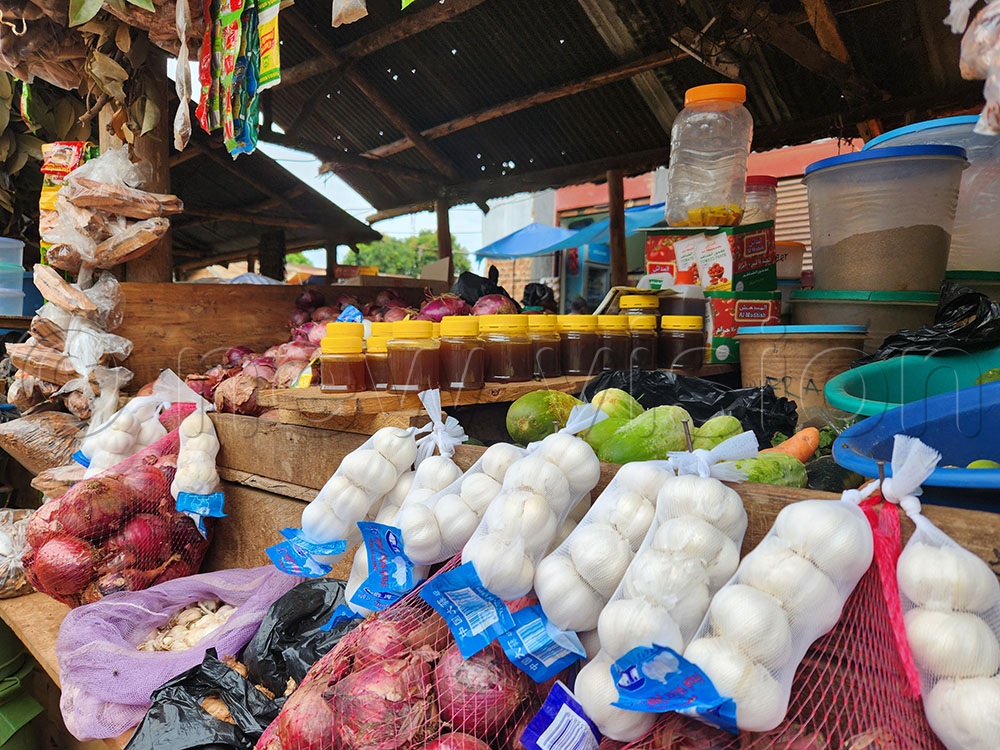
Samples of honey and other vegetables being sold in Seeta Central Market Mukono district. This was on March 3, 2025. (Credit: Lawrence Mulondo)
Richard Serunjogi, chairperson of Seeta Central Market traders, says market leaders play a role in guiding vendors on quality control. Through partnerships with the nearby Ntaawo Farm Institute, traders attend farm trainings where they are sensitised on the standards of produce expected in the market.
Most vendors buy directly from farms, while some farmers deliver produce to the market. The area also serves residents from neighbouring countries who rely on Seeta for groceries.
Serunjogi says market leaders classify produce into first, second and third grades, depending on appearance and condition, with prices varying accordingly.
Vendors prefer produce spread on the farm to ensure freshness and reduce pest damage. For honey, traders encourage the sale of comb honey to minimise adulteration.
Although unaware of formal national standards, he says vendors rely on experience and regular meetings to maintain acceptable quality levels.
Established in 1989 under the UNBS Act, Cap 210, UNBS was mandated to formulate national standards and promote standardisation in commerce, industry, health and safety.
The body also enforces measures to protect the public from harmful ingredients, dangerous components and substandard goods.
During a recent media training on standards and Metrology reporting organised by UNBS and Ultimate Multimedia Consult with support from UKaid and Trade Mark Africa in Mukono, Daniel Arorwa, Surveillance Manager at UNBS, described a standard as a document defining minimum specifications for a product or process.
Developed by experts, he said, standards represent consensus based on best practice.
“A substandard product fails to meet required specifications and may be unsafe,” Arorwa noted, adding that certification is mandatory for products covered by compulsory standards in health, safety and environmental protection.
He urged entrepreneurs to use government regional laboratories to test and certify their products, enabling them to access national and regional markets.
According to UNBS, substandard goods often stem from smuggling, counterfeiting, misuse of the Q-mark and porous borders.
While the bureau has intensified public awareness and partnerships to curb the vice, Arorwa acknowledged challenges including inadequate staffing, limited equipment and inconsistent funding.
Back in Seeta Market, however, standards remain an abstract concept. Here, trust is currency, feedback is regulation, and survival often outweighs certification.
As customers haggle and traders count their earnings, a quiet question lingers in the background: at what cost does this trust come?