
Keep children out of political rallies, say Unicef, UHRC
UHRC commissioner Crispin Kaheru says children are being put in campaign processions, donning party-coloured T-shirts, which affects their mental well-being in the end.
(L-R) Lamex Omara, a commissioner of the Uganda Human Rights Commission, with Dr Robin Nandy, the UNICEF Representative, Simeo Nsubuga, a commissioner of UHRC, and Crispin Kaheru, a commissioner, during a press conference to promote and safeguard the rights and freedoms of children during electoral processes on Dec. 8, 2025. (Credit: Nicholas Oneal)
_____________________
Since the 2026 General Election campaigns started, reports of children being used at campaign rallies have refused to go away.
It is based on these reports that the Uganda Human Rights Commission and the United Nations Children's Fund (UNICEF) have condemned the act, noting that it is out of context and detrimental to children.
UHRC commissioner Crispin Kaheru says children are being put in campaign processions, donning party-coloured T-shirts, which affects their mental well-being in the end.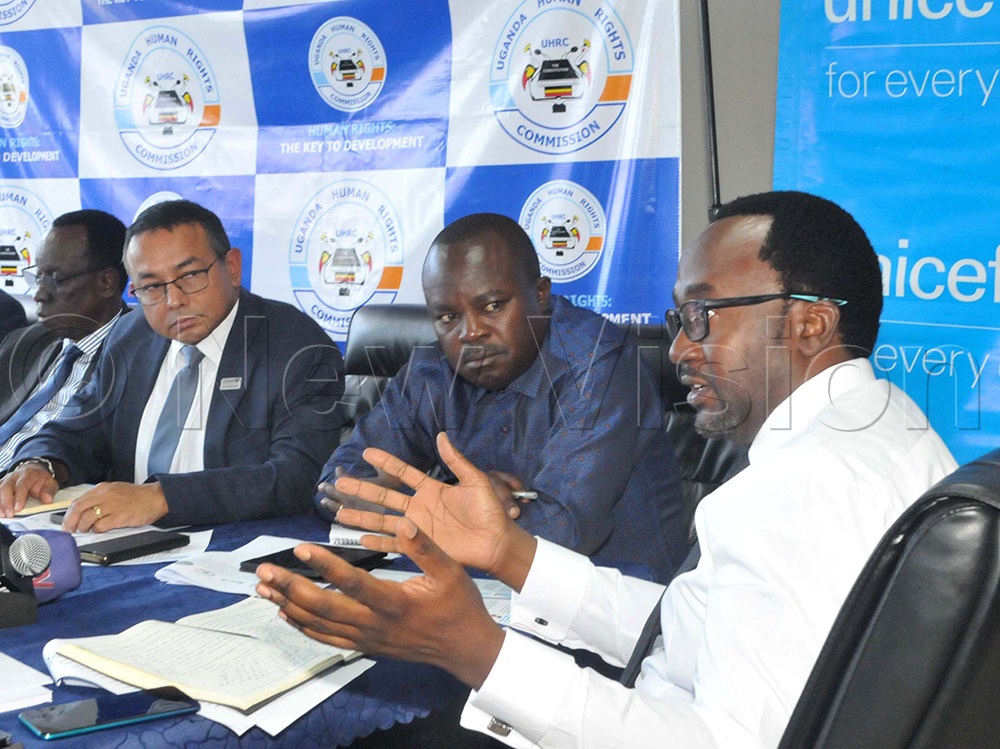
Dr Robin Nandy (Left), the UNICEF Representative, looks on with Simeo Nsubuga, a commissioner, as Crispin Kaheru, a commissioner of the Uganda Human Rights Commission, speaks during a press conference to promote and safeguard the rights and freedoms of children during electoral processes on Dec 8, 2025. (Credit: Nicholas Oneal)
During a joint press conference at the UHRC head office in Kampala on December 9, 2025, Kaheru said he was concerned that political parties have continuously used children as part of their crowds at some events.
“We have seen footage of children on cars campaigning for one of the candidates in Rubanda district,” he said.
Kaheru said at political rallies, children are made to carry posters, dance, and sing songs commending a certain candidate, yet they are considered vulnerable.
“Campaigns and politics are very risky for children, so it is important to keep them out,” he said.
Lamex Omara Apitta, who represented UHRC chairperson Mariam Wangadya, said, “Today we are emphasising that children must be kept out of political spaces and protected from harm. We remind Ugandans that elections are a cornerstone of democracy and a moment to prioritise the well-being and rights of every child. Elections should never come at the expense of the safety and well-being of Uganda’s children.”
Apitta said that political parties must commit to child-friendly policies and practices that promote the rights of children, other than engaging them in politics, which they hardly understand.
During elections, children are caught in crossfire, according to Damon Wamara, the executive director of Uganda Child Rights and NGO network. He stressed that children are used as campaign agents, which creates tension among them and communities. He highlighted that in some cases, they are targeted and injured, which leaves a long-term trauma that affects their physical growth.
“Some children are ferried to campaign rallies after they get stuck. No one bothers to pick them back home,” he said.
Opitta said half of Uganda’s population is youth. At the childhood level, when they are not protected from all cases that traumatise them, they never grow to become productive citizens in communities.
Dr Robin Nandy, a representative of Uganda's country office, said the young population can contribute so much if properly raised in a quiet environment. To secure their future, he said that the health sector, education must be given the first priority to help them attain a better understanding.
Pauline Nansamba Mutumba, the director of complaints, investigations, and legal services Ugandan human rights commission, said that whereas children are coerced into being in political campaigns, they may not be aware of the dangers.
Background
Scholars such as Steven Chaffee of the University of Michigan were among the first to show that political campaigns influence young people by shaping their political knowledge and awareness through mass-media exposure.
His work, along with early findings from major communication researchers in the US, demonstrated that when children and adolescents watch campaign messages, news, or political advertising, they begin forming attitudes about leaders and political issues. Alongside Chaffee, M. Kent Jennings of the University of California, Santa Barbara, and the University of Michigan is widely recognised for foundational research in political socialisation.
His long-term studies demonstrated that young people acquire political attitudes through family, school, and community interactions, but that campaign seasons intensify this learning by increasing political discussion and visibility.
More recent scholars from the Youth and Participatory Politics (YPP) Research Network, including Joseph Kahne (Mills College), Ellen Middaugh (Mills College), and Nam-Jin Lee (College of Charleston), have expanded this work into the digital era. Their studies show that social-media-based campaign communication increases adolescents’ exposure to political ideas, encourages political discussion with peers, and can strengthen young people’s sense of political efficacy. These scholars argue that online political content, especially during campaign periods, can activate youth political interest even before they reach voting age.
However, research also highlights significant risks for children in more polarised or conflict-affected contexts. Psychologists such as Eric F. Dubow and L. Rowell Huesmann of the University of Michigan’s Institute for Social Research, working with collaborators from the Hebrew University of Jerusalem and the Palestinian Centre for Policy and Survey Research, have found that children exposed to political violence or hostile campaign environments show higher levels of emotional distress and aggression. Their studies indicate that when political campaigns involve fear, conflict, or ethnic tension, children can internalise aggressive norms or develop negative attitudes toward other groups.