
Over 20,000 CHEWs trained as Uganda expands access to family planning
The health ministry says strengthening family planning services at parish and village levels is critical, as Uganda continues to register high fertility rates and a significant number of unintended pregnancies.
Participants share a group photo after the meeting between the health ministry, Makerere University and PATH on Feb. 3, 2026, at Hotel Africana. (Credit: Annabel Oyera)
________________
Ministry of Health says community-based delivery of family planning services is beginning to close long-standing access gaps, particularly in rural and hard-to-reach areas. The development is in light of the country's work toward achieving a 50 per cent modern contraceptive prevalence rate by 2030.
A total of 20,363 community health workers, including Community Health Extension Workers (CHEWs) and Village Health Teams, have so far been digitised under the national community health programme, with another 20,000 expected to be enrolled by March 2026, according to ministry data. The workers are supported through the electronic Community Health Information System (eCHIS), a digital platform used to register households, track services and automate reporting from community to national level.
As part of efforts to strengthen access to long-term contraceptive methods, the ministry recently piloted community-level provision of Implanon implants by CHEWs. The pilot was implemented in Kyotera, Namutumba, Lira and Lira City, targeting task-sharing, reduced congestion at health facilities and lower transport-related barriers for women and girls.
The CHEWs programme, which was adapted from Ethiopia’s community health model, was introduced following learning visits led by the Ministry of Health under the leadership of then minister Dr Jane Ruth Aceng. CHEWs are currently deployed at parish level, where they supervise Village Health Teams and serve as a direct link between communities and nearby health facilities.
Resistance to programme declining
Director General of Health Services Dr Charles Olaro says initial resistance to the programme, driven largely by misconceptions about family planning, has gradually declined due to sustained community engagement. He added that the ministry plans to scale up the training and deployment of CHEWs as it addresses gaps identified during the pilot phase.
Through the digital community health system, approximately 2.4 million households, representing nearly 5.9 million people, are now registered and receiving routine community health services. Between 2022 and 2023, health officials report that over 1.75 million pregnancies were registered and supported, while more than 57,000 referrals were made for services such as immunisation, nutrition and management of childhood danger signs.
The health ministry says strengthening family planning services at parish and village levels is critical, as Uganda continues to register high fertility rates and a significant number of unintended pregnancies.
These revelations were made during a meeting between the health ministry, Makerere University and PATH to share the results of the CHEWs pilot project. The pilot, done in Kyotera, Namutumba, Lira, and Lira City, helped women and girls get family planning services in their communities. The meeting was at Hotel Africana in Kampala City on February 3, 2026.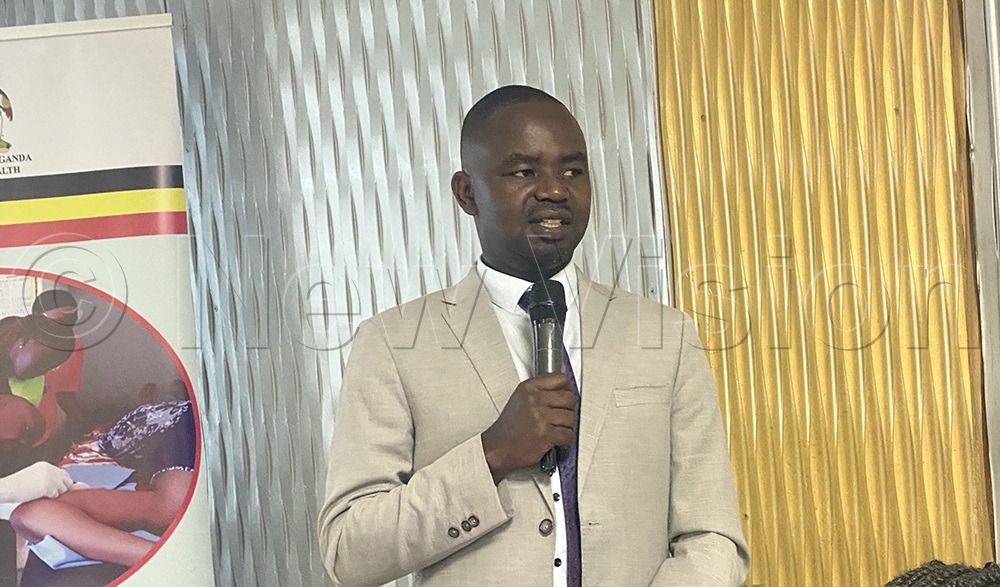
Reproductive health services commissioner Dr Mugahi Richard. (Photo by Annabel Oyera)
Reproductive health services commissioner Dr Mugahi Richard highlighted the importance of family planning in national development, emphasising that children should be born by choice, not chance. He praised the pilot districts for successfully implementing community-based interventions, including VHTs (Village Health Teams) for maternal and child health.
He called for systematic engagement of religious leaders, robust policy support, and sustainable funding. Mugahi stressed that family planning reduces unintended pregnancies, improves maternal and child health, and strengthens overall community well-being.
At the community level, CHEWs report growing acceptance of long-term contraceptive methods due to increased counselling and regular outreach. Alech Nancy Mirriam, a CHEW attached to Anyangatir Health Centre III in Lira city, said most women accessing services are between 24 and 40 years old, with many opting for the three-year implant after receiving adequate information.
Low male involvement
However, Mirriam identified low male involvement, persistent myths surrounding implants, long distances and limited outreach resources as ongoing challenges.
“When men are actively involved, uptake of family planning services improves significantly,” she said, calling for more deliberate strategies to engage men at the community level.
Despite these challenges, health officials say the presence of CHEWs has eased pressure on health facilities by reducing waiting times and improving trust, as services are delivered by health workers who live and work within the communities they serve.
The health ministry is working in partnership with Makerere University School of Public Health and PATH to monitor the programme and ensure continued improvements in community-based family planning service delivery.