
Uganda pushes for climate-smart agriculture as climate shocks escalate
The meeting, organised by the Environment for Development Makerere (EfD MAK) Centre through its regional Inclusive Green Economy (IGE) Programme, sought to strengthen the link between research, policy and practical solutions that can help farmers withstand worsening climate impacts.
Emmanuel Odeng, an official from the ministry of agriculture, animal Industry and fisheries, presenting the keynote address. (Photo by John Odyek)
___________________
Uganda is racing against time to protect its agriculture sector from intensifying climate shocks, declining productivity and rising poverty.
Researchers, government officials and private sector actors have met to design a national roadmap for accelerating the adoption of Climate Smart Agriculture (CSA).
The meeting, organised by the Environment for Development Makerere (EfD MAK) Centre through its regional Inclusive Green Economy (IGE) Programme, sought to strengthen the link between research, policy and practical solutions that can help farmers withstand worsening climate impacts.
The annual IGE initiative is intended to help public servants turn research into actionable interventions. This year’s focus on CSA underscores its growing importance in sustaining production, building resilience and supporting food security across Uganda’s agricultural value chains.
Agriculture at a crossroads
Presenting the keynote address on behalf of the commissioner of the Ministry of Agriculture, Animal Industry and Fisheries (MAAIF), Emmanuel Odeng warned that Uganda’s agricultural backbone is weakening under the strain of climate change and inadequate investment in resilient food systems.
The meeting took place on December 4, 2025, at the Sheraton Kampala Hotel.
Agriculture remains central to Uganda’s economy, contributing 24 percent of GDP, 35 percent of export earnings and employing more than 80 percent of the population. Yet its GDP contribution has dropped sharply from 34.1 percent in 2009 to 24 percent in 2022, signalling stagnation in a sector that is vital for poverty reduction.
“Yields are decreasing, water sources are shrinking, and heatwaves are rising. Communities are becoming more vulnerable,” Odeng said. Between 2019 and 2021 alone, 1.4 million Ugandans slipped back into poverty as climate shocks eroded household resilience.
He cited recurring droughts, floods, landslides and the rapid degradation of forests, wetlands and water bodies, including Lake Kyoga, as major drivers of vulnerability. More than 6,000 wetlands now face encroachment as natural resource degradation accelerates.
CSA seen as the path to agricultural recovery
Odeng emphasised the urgent need to scale up CSA interventions across crop, livestock and fisheries value chains. Priority areas include agroecology, soil rehabilitation, irrigation and water harvesting, mechanisation, climate-resilient seeds, afforestation, agroforestry and improved post-harvest handling.
He said MAAIF aims to increase production by 40 percent through updated CSA compendiums and resilient value chains developed in partnership with the National Agricultural Research Organisation (NARO).
Odeng asked stakeholders to reflect on three guiding questions: Which CSA interventions can build farmer resilience and reduce poverty? Which approaches can sustainably improve productivity? Which strategies can reduce post-harvest losses and strengthen food security?
“These are the questions that must guide our future research, policies and investments,” Odeng said.
Stronger research and policy partnerships
Dr John Sseruyange, speaking on behalf of the EfD-Mak Centre, warned that Uganda is experiencing severe climate impacts that threaten rural livelihoods and national development.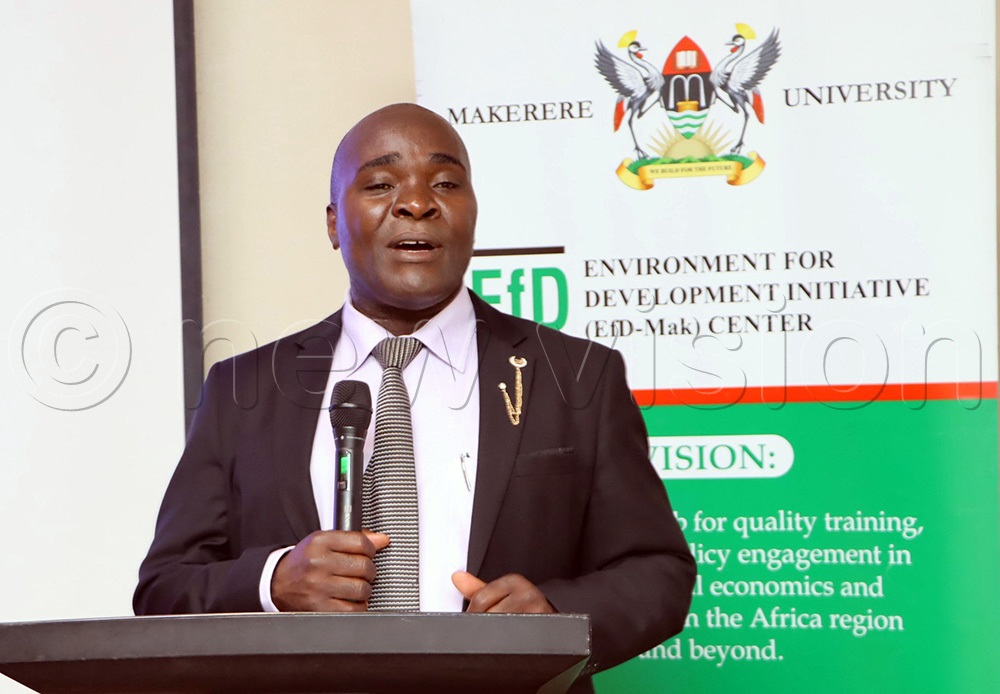
Dr. John Sseruyange from the EfD Mak Centre addressing participants. (Photo by John Odyek)
Sseruyange noted that shrinking wetlands, degraded soils and declining water sources are undermining agricultural output, leaving farmers increasingly exposed.
“Climate change is no longer distant. It is happening today, and it is affecting the very sector that sustains our economy,” he said.
He stressed that meaningful CSA adoption requires closing the gap between research and policy. Research that is not aligned to policy priorities, he warned, risks remaining unused. EfD’s annual workshops are designed to ensure that scientific evidence directly informs government decisions.
He outlined three key research questions identical to those raised by Odeng, underscoring their central role in shaping Uganda’s CSA agenda.
Threats to food security
EfD policy engagement specialist Dr Peter Babyenda expressed concern about Uganda’s slow adoption of CSA despite its clear benefits, which include boosting productivity, improving resilience and contributing to climate mitigation.
Babyenda noted that agriculture contributes 23.8 percent of GDP and employs nearly 70 percent of Uganda’s working population, yet remains highly vulnerable because 96 percent of households rely on rain-fed farming. Rising temperatures, erratic rainfall, droughts, floods and increasing pest outbreaks continue to threaten food systems.
“If Uganda is to meet its food security and development goals, scaling up CSA is not optional; it is essential,” Babyenda said.
He highlighted barriers to CSA adoption, including high input costs, limited access to technologies, weak extension services and low farmer awareness. He called for gender-responsive and youth-inclusive policies, expanded farmer training and stronger CSA-focused extension services.
Boosting farmer adoption
IGE fellow Thomas Opeet presented the Transformation Initiative (TI), a research-led effort aimed at addressing adoption barriers for smallholder farmers. Opeet outlined challenges such as low farmer awareness, inadequate extension support, high input costs and weak institutional capacities.
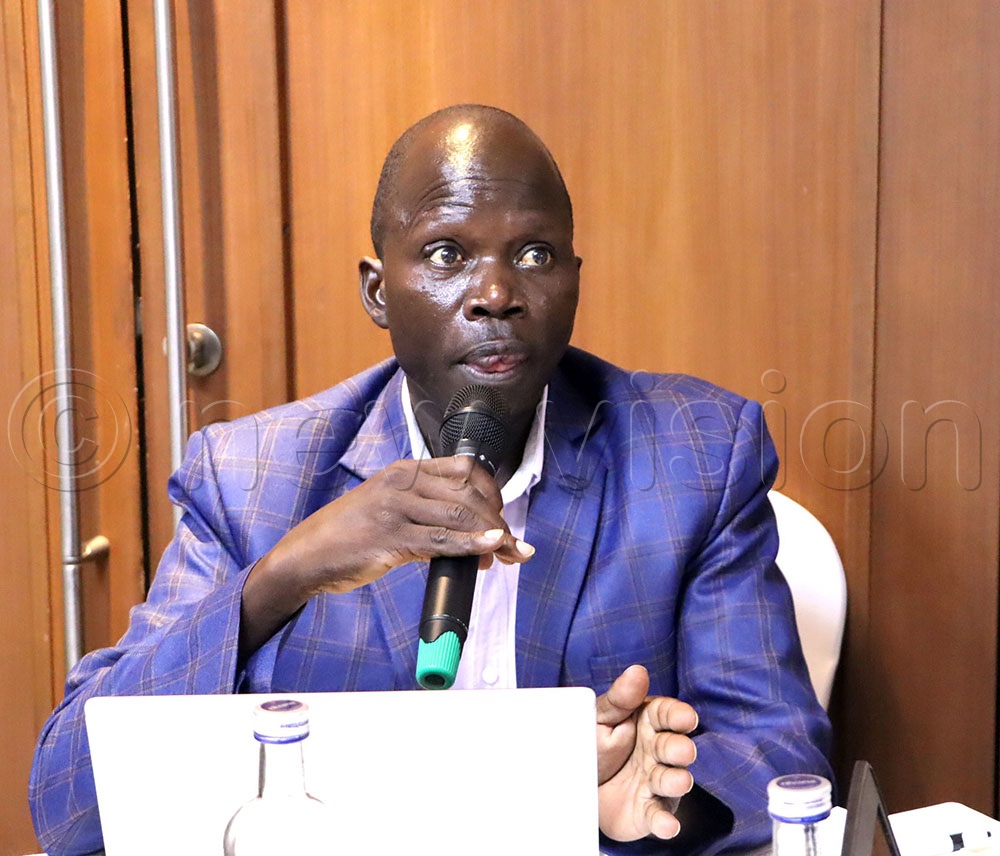
Thomas Opeet IGE fellow contributing to the discussion. (Photo by John Odyek)
“Extension workers are critical intermediaries, yet many lack the capacity, transport or tools to reach farmers,” Opeet said.
He emphasised the triple-win benefits of CSA, increased productivity, greater resilience and reduced emissions and highlighted technologies such as small-scale irrigation and insect-based livestock feed that could be transformative if scaled effectively.
Opeet warned, however, that high input costs, limited water access, land constraints and youth disinterest continue to hinder adoption. He called for increased research funding, stronger policy support and expanded farmer education to overcome these gaps.
Building a climate-resilient agricultural future
Participants agreed on the need for stronger policy engagement, improved extension services and deeper collaboration between researchers, policymakers and farmers. Key priorities identified include research that enhances resilience and reduces poverty, CSA interventions that sustainably raise productivity, and strategies that reduce post-harvest losses while improving market outcomes.
Stakeholders advocated for community-based extension models, farmer-to-farmer learning and affordable CSA technologies that do not impose additional burdens on smallholders or strain the national treasury.