
Luwero leaders asked to mobilise pineapple farmers to supply new processing factory
The call was made by the outgoing Minister of Agriculture, Animal Industry, and Fisheries, Frank Tumwebaze, while flagging off the first 100 metric tons of canned pineapples to China. The fruits were canned in Uganda, specifically in Luwero District.
Minister of Agriculture, Animal Industry, and Fisheries Frank Tumwebaze during the flagging off the first 100 metric tons of canned pineapples to China. (Courtesy photo)
_________________
Local leaders and extension workers based in Luwero and Nakaseke districts have been asked to mobilise farmers to grow enough pineapples to feed the newly established processing factory stationed at the Luwero China Agro Industrial Park.
The call was made by the outgoing Minister of Agriculture, Animal Industry, and Fisheries, Frank Tumwebaze, while flagging off the first 100 metric tons of canned pineapples to China. The fruits were canned in Uganda, specifically in Luwero District.
“Local leaders and extension workers should guide and mobilise farmers to start farms in a sustainable way to produce enough raw materials for the industry while targeting the market,” he said.
Owen Yin, a representative of the factory owners, stated that the 104 metric tons of canned pineapples is the first batch exported directly to China from Deshiburg Company.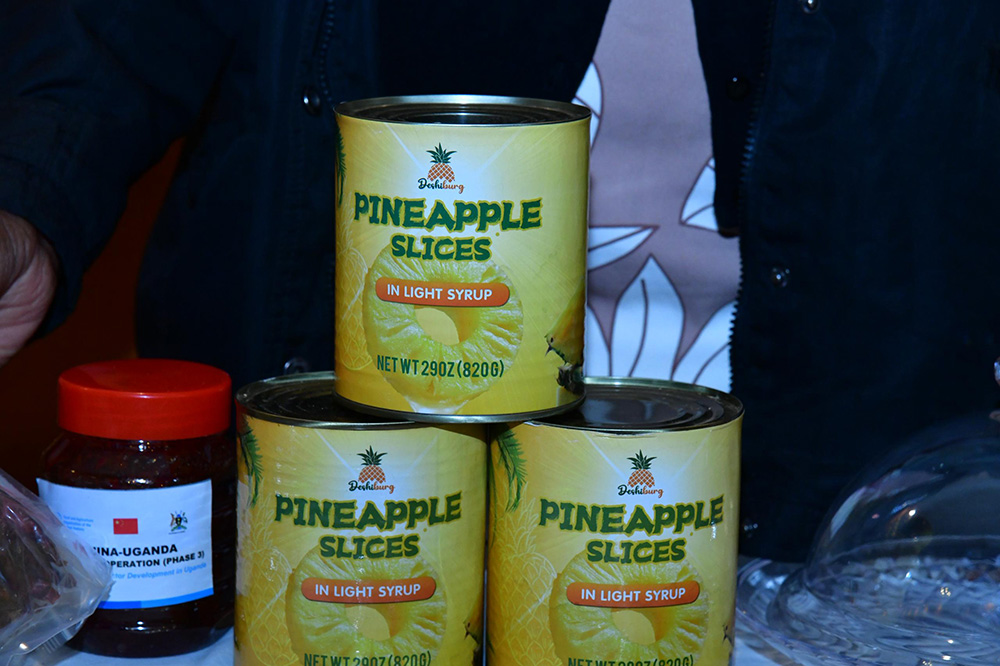
Some of the canned pineapple samples. The first 100 metric tons of canned pineapples have been flagged off to China. (Courtesy photo)
He explained that the establishment of Deshiburg stems from the deep cooperation of four strong partners: a seasoned company with 37 years of experience in canned food production in China, WW Group, the second-largest canned food importer in the United States, Zhongyang Group, an industrial park company with 25 years of experience in Nigeria, and Linyi Atlantis Import & Export Co., Ltd., with 22 years of experience in international trade.
With a total investment of US$11 million (around sh40b), the facility is poised to create both direct and indirect jobs.
“We are particularly proud that Deshiburg is Uganda's first modern factory dedicated to the production of canned pineapples. Our factory is operating at full capacity with a powerful daily processing capacity of 500 tons of locally sourced pineapples,” Yin said.
For continuity, he advised farmers to plant more and better high-quality pineapple varieties such as SmoothCayenne and especially MD-2.
On the same occasion, the UN Resident Coordinator Leonard Zulu said that Uganda is at a pivotal moment. For many years, the country exported mainly raw agricultural commodities, but it is now on a strategic shift towards value addition, quality processing, and competitiveness in international markets.
“This transition is critical. Moving up the value chain creates jobs, increases export earnings, and strengthens economic resilience. It also aligns strongly with Uganda’s national priorities on agro-industrialisation, export promotion, and job creation,” he said.
He also hailed the partnerships and collaborations being initiated between government and the private sector, investors, farmers, and development partners, adding that the initiative will increase investments into value addition within Uganda.
“We also see the value of South-South and triangular cooperation, particularly between Uganda and China, supported by FAO, in transferring knowledge, technology, and investment. This is exactly the kind of integrated, inclusive approach needed to accelerate sustainable development outcomes,” Zulu added.
Ezana Kassa, the country representative of the Food and Agriculture Organisation (FAO), said that the export of the 100 metric tons of processed pineapple signals that Uganda is ready to compete in demanding global markets.
He, however, added that continued exports will depend on compliance with international standards, that is, food safety and quality standards, efficient processing and logistics systems, reliable supply chains anchored in smallholder farmers, which require reliable aggregation mechanisms among others.